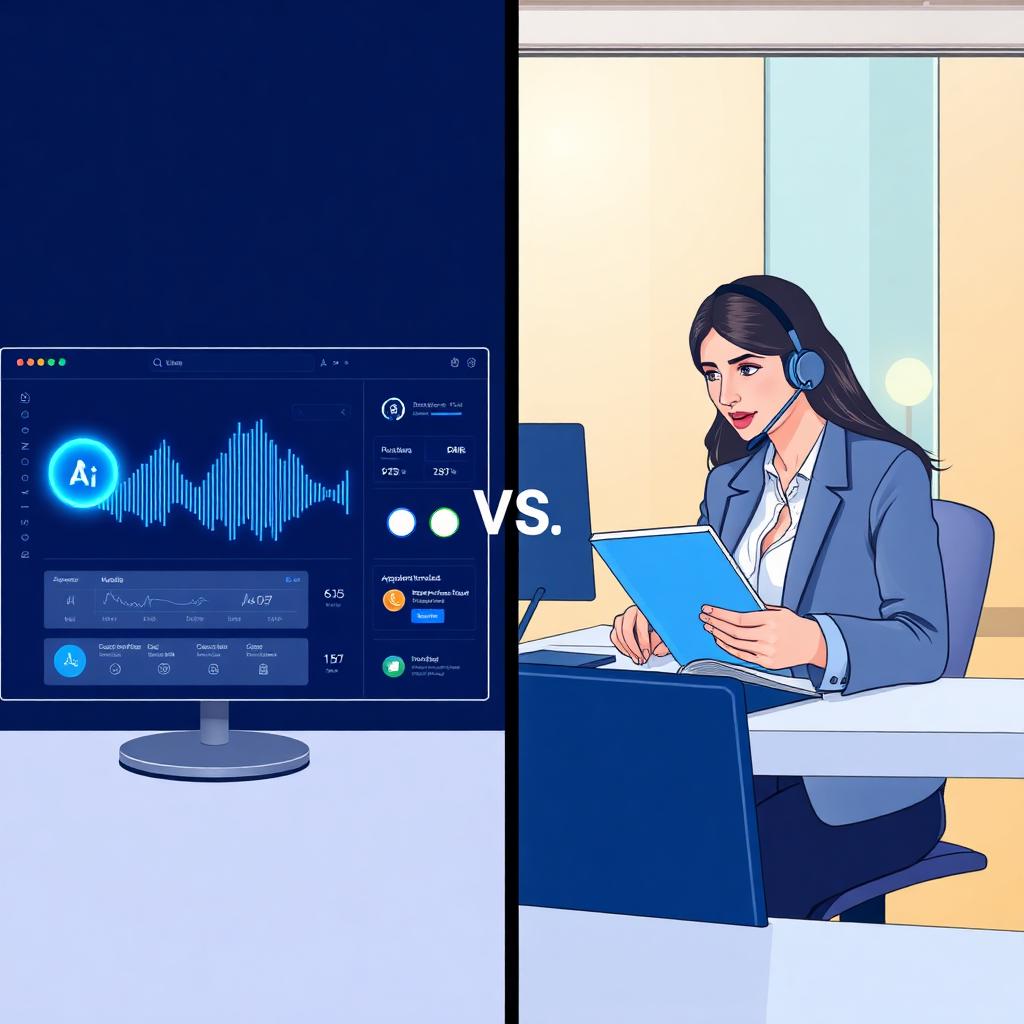
Every growing business eventually hits the same wall: the phone keeps ringing, but nobody can answer it fast enough. In 2026, that decision no longer comes down to "hire another receptionist or lose the call." It comes down to a strategic question — AI Receptionist vs Human Receptionist, or a hybrid of both.
A decade ago, front-desk work meant a person with a headset, a paper calendar, and a smile. Today, an AI Receptionist can answer in under one second, qualify a lead, book an appointment into Google Calendar, push the contact into HubSpot, send an SMS follow-up, and route hot callers to a live human — all before a human receptionist would have finished saying "good morning."
But speed is not the whole story. Human receptionists still bring empathy, nuance, judgment, and a physical presence that AI cannot replicate. So which one is actually better for *your* business in 2026? This guide gives you the honest, side-by-side breakdown — cost, productivity, customer experience, ROI, pros, cons, and a decision framework you can use today.
TL;DR
- AI Receptionists win on cost, speed, availability, scalability, and after-hours coverage.
- Human Receptionists win on empathy, complex judgment, in-person hospitality, and emotionally sensitive calls.
- For most SMBs in 2026, a hybrid model (AI handles 70–90% of calls, humans handle the rest) delivers the best ROI.
- Typical AI Receptionist ROI: 3x–8x within the first 6 months versus hiring one full-time front-desk employee.
- Use AI when call volume is unpredictable, after-hours, or repetitive. Use humans when calls require deep empathy, on-site tasks, or VIP handling.
Table of Contents
- 1. What Is an AI Receptionist?
- 2. What Is a Human Receptionist?
- 3. Quick Comparison Table
- 4. Feature-by-Feature Comparison
- 5. Cost Comparison
- 6. Productivity Comparison
- 7. Customer Experience Comparison
- 8. AI Receptionist Pros
- 9. Human Receptionist Pros
- 10. AI Receptionist Limitations
- 11. Human Receptionist Limitations
- 12. Which Businesses Should Choose AI Receptionists?
- 13. The Hybrid Model
- 14. ROI Comparison
- 15. Decision Framework
- 16. Frequently Asked Questions
- 17. Key Takeaways
- 18. Conclusion
What Is an AI Receptionist?
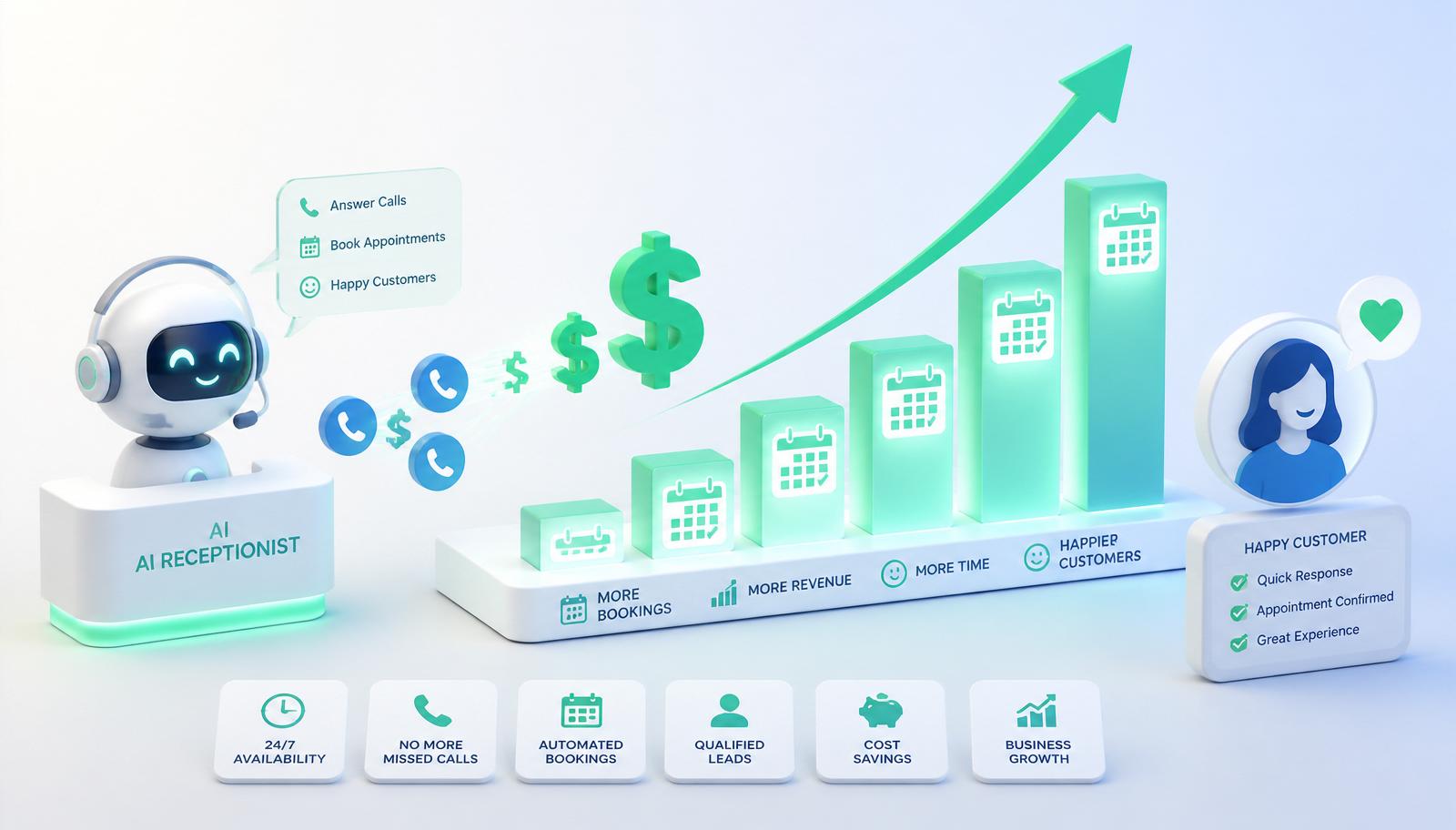
An AI Receptionist is a voice-and-chat agent powered by large language models, speech recognition, and workflow automation. It answers inbound calls, handles live chats, books appointments, qualifies leads, routes calls, and syncs every interaction with your CRM and calendar — 24/7, in multiple languages, with zero hold time.
Modern AI Receptionists (see our full [What Is an AI Receptionist](/blog/what-is-an-ai-receptionist) guide) go far beyond the old "press 1 for sales" IVR menus. They understand natural language, remember context across a conversation, follow business-specific scripts, and trigger downstream automations (SMS, email, CRM updates, Slack alerts) in real time.
In short: an AI Receptionist is a fully trained, always-on digital front desk that scales instantly and never sleeps.
What Is a Human Receptionist?
A Human Receptionist is a trained employee — full-time, part-time, virtual, or through an answering service — who answers calls, greets visitors, books appointments, and handles administrative tasks. They bring judgment, empathy, and situational awareness that machines still cannot fully match.
Human receptionists come in three flavors:
- In-house receptionist — full-time employee, on-site.
- Virtual receptionist — remote human, often shared across multiple businesses.
- Answering service / call center — pay-per-minute or pay-per-call human coverage.
Each model has different costs, availability windows, and consistency levels — which we'll break down below.
Quick Comparison Table
- Availability — AI: 24/7/365. Human: business hours only.
- Answer speed — AI: under 1 second. Human: 15–60 seconds.
- Monthly cost — AI: $99–$999. Human FTE: $3,500–$5,500.
- Concurrent calls — AI: unlimited. Human: 1 at a time.
- Languages — AI: 30+. Human: typically 1–2.
- CRM sync — AI: automatic. Human: manual.
- Sick days / turnover — AI: none. Human: regular.
- Empathy & nuance — AI: good, improving. Human: excellent.
- Complex judgment — AI: limited. Human: excellent.
- Scalability — AI: instant. Human: slow (hire + train).
- Consistency — AI: 100% script-perfect. Human: varies by person/day.
Feature-by-Feature Comparison
Availability
AI: 24/7/365, including weekends, holidays, and after hours. Human: typically 40 hours/week; requires 3+ FTEs to cover 24/7. Winner: AI.
Call Answering Speed
AI: sub-second pickup, zero hold time, unlimited concurrency. Human: 15–60 seconds average; longer during peak times. Winner: AI.
Customer Experience
AI: consistent, polite, on-script every time. Modern voice AI sounds natural and empathetic. Human: warmer emotional connection, better at reading tone and de-escalating upset callers. Winner: tie — depends on call type.
Appointment Booking
AI: reads real-time calendar availability, books directly into Google, Outlook, or Calendly, sends confirmations and reminders automatically. Human: manually checks calendar, types details, sometimes double-books. Winner: AI.
Lead Qualification
AI: runs a consistent qualification script (BANT, budget, timeline, intent) on every call, scores the lead, and routes accordingly. Human: qualification varies by employee, mood, and workload. Winner: AI.
CRM Integration
AI: native integrations or via n8n/Zapier — every call auto-logs to HubSpot, Salesforce, Pipedrive, GoHighLevel, and more. Human: manual data entry, often skipped or delayed. Winner: AI.
Workflow Automation
AI: triggers SMS, email, Slack, tasks, and multi-step workflows the second a call ends. See [n8n Automation](/n8n-automation). Human: requires manual follow-up, prone to being forgotten. Winner: AI.
Accuracy
AI: 95–99% intent recognition; near-perfect structured data entry. Human: typos, mishearings, and forgotten details are common under load. Winner: AI for structured data.
Scalability
AI: handle 1 or 10,000 concurrent calls with no additional hiring. Human: each additional call requires an additional person. Winner: AI.
Languages
AI: 30+ languages out of the box, switch mid-call. Human: usually 1–2 languages per employee. Winner: AI.
Training
AI: update the knowledge base once → deployed instantly across every call. Human: days-to-weeks of training per hire, ongoing coaching required. Winner: AI.
Reporting & Analytics
AI: every call transcribed, tagged, sentiment-scored, and dashboarded in real time. Human: ad-hoc notes; deep analytics require expensive call-center software. Winner: AI.
Security & Compliance
AI: SOC 2, HIPAA, GDPR, and PCI-compliant vendors available; consistent redaction. Human: depends heavily on individual training and discipline. Winner: AI when the vendor is properly certified.
Reliability
AI: no sick days, no vacation, 99.9%+ uptime SLA. Human: sick days, ~30–40%/yr turnover, burnout. Winner: AI.
Cost Comparison
Monthly Cost
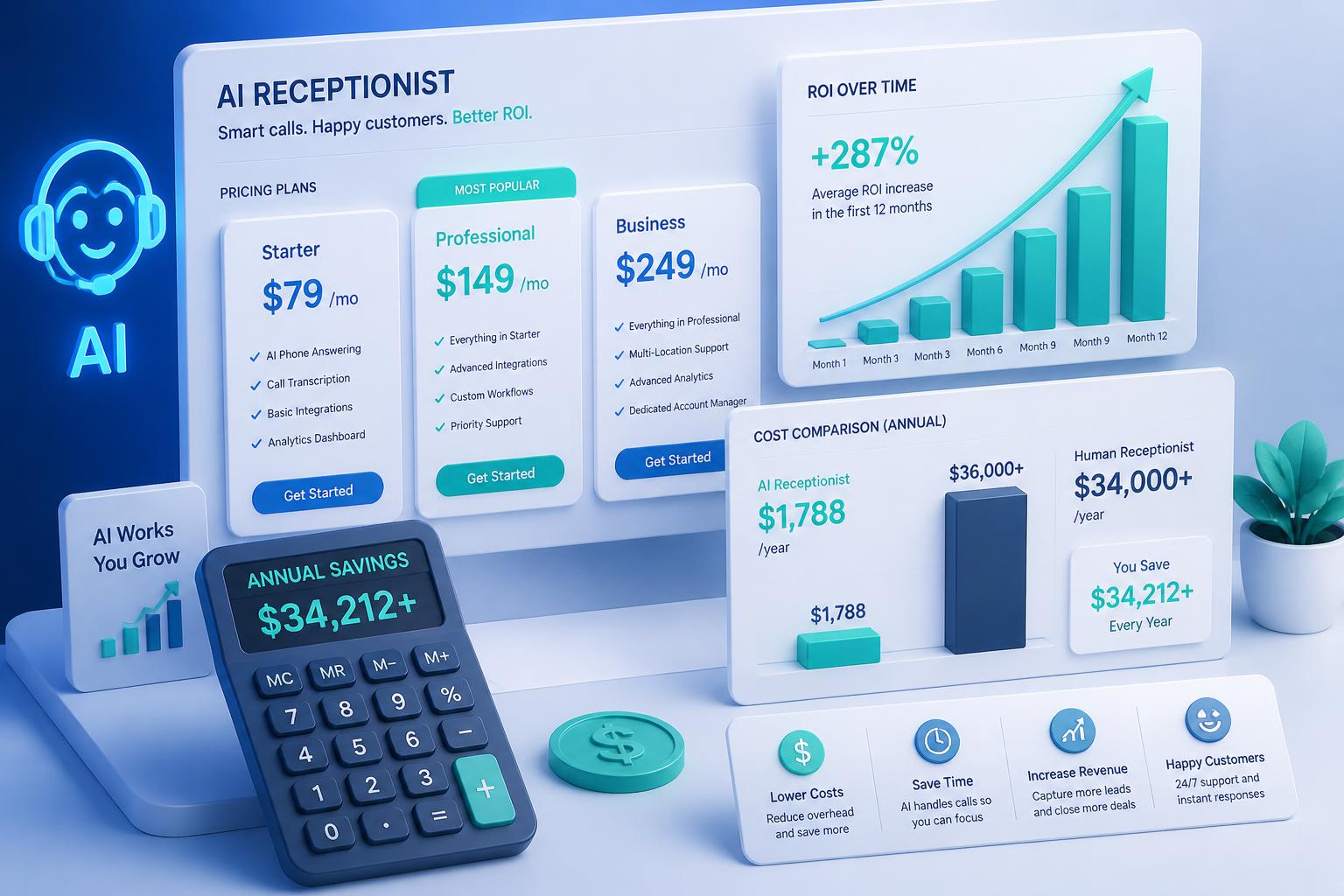
- AI Receptionist (Starter): $99–$299/mo
- AI Receptionist (Pro): $299–$999/mo
- Virtual human receptionist: $300–$1,500/mo
- Answering service (per-minute): $400–$2,500/mo
- In-house full-time receptionist: $3,500–$5,500/mo (salary + taxes + benefits)
Annual Cost
- AI Receptionist: $1,200–$12,000/year
- Virtual receptionist: $3,600–$18,000/year
- Answering service: $4,800–$30,000/year
- In-house FTE: $42,000–$66,000+/year
Total Cost of Ownership (12 months)
TCO includes software, training, benefits, equipment, turnover, and missed-call opportunity cost.
- AI Receptionist: ~$6,000 TCO + ~$0 missed-call cost (24/7) = $6,000
- Virtual receptionist: ~$12,000 TCO + $4,000–$10,000 missed calls = $16,000–$22,000
- In-house FTE: ~$54,000 TCO + $8,000–$20,000 after-hours misses = $62,000–$74,000
For a full pricing deep-dive, see the [AI Receptionist Pricing Guide](/blog/ai-receptionist-pricing-guide).
Productivity Comparison
- Calls handled per hour — AI: unlimited. Human: 8–15.
- Average handle time — AI: 60–120 seconds. Human: 3–5 minutes.
- Data entry accuracy — AI: 99%. Human: 80–90%.
- Follow-ups sent — AI: automatic. Human: often missed.
- After-hours coverage — AI: 100%. Human: 0%.
AI Receptionists are simply more productive per dollar — but humans still outperform AI on complex, emotionally sensitive, or highly customized conversations.
Customer Experience Comparison
Modern AI voice agents in 2026 use neural TTS that is nearly indistinguishable from a human on routine calls. Recent industry surveys show:
- 73% of callers say they don't mind AI if their issue is resolved quickly.
- 68% prefer AI for after-hours support over voicemail.
- 62% still prefer humans for complaints, refunds, and emotional conversations.
The winning strategy: AI answers first, human takes over when needed.
AI Receptionist Pros
- 24/7 availability
- Instant answer, zero hold
- Unlimited concurrency
- Consistent script every time
- Automatic CRM + calendar sync
- Multilingual by default
- Full analytics on every call
- 5–20x cheaper than an FTE
- No sick days, no turnover
- Scales instantly with demand
See the full list in [AI Receptionist Benefits](/blog/ai-receptionist-benefits).
Human Receptionist Pros
- Genuine empathy and rapport
- Handles complex, unpredictable situations
- Physical presence for walk-in visitors
- Better for VIP / high-touch clients
- Judgment calls (emergencies, escalations)
- Deep local/cultural nuance
- Trusted for sensitive industries (bereavement, legal, healthcare crises)
AI Receptionist Limitations
- Struggles with highly emotional or ambiguous calls
- Requires setup and knowledge-base maintenance
- Rare misunderstandings on heavy accents or poor audio
- Cannot physically greet visitors
- Needs human fallback for edge cases
Human Receptionist Limitations
- Expensive (salary + benefits + turnover)
- Available only during work hours
- One call at a time
- Inconsistent quality
- Manual data entry → CRM gaps
- Cannot scale during traffic spikes
- Vulnerable to burnout and churn
Which Businesses Should Choose AI Receptionists?
Dental Clinics
High volume of appointment bookings, insurance questions, and reminder calls. AI handles 80%+ effortlessly — humans focus on chairside care.
Medical Practices
HIPAA-compliant AI Receptionists triage symptoms, book visits, and route emergencies to on-call staff 24/7.
Law Firms
After-hours intake is a goldmine — AI qualifies leads and books consultations while competitors send calls to voicemail.
HVAC & Home Services
Emergency calls at 2 a.m.: AI dispatches, books, and texts the technician instantly.
Real Estate
AI captures buyer/seller leads from listings 24/7, qualifies budget and timeline, and books showings.
Insurance
AI handles quote intake, policy questions, and claims routing at scale during storm season without hiring surges.
SaaS
AI answers pricing, demo, and support questions instantly, books demos into AE calendars, and syncs to HubSpot/Salesforce.
Marketing Agencies
AI handles inbound discovery calls, qualifies against ICP, and books strategy sessions — freeing founders from phone tag.
Explore vertical case studies in [Case Studies](/case-studies).
The Hybrid Model
The most successful businesses in 2026 don't choose *AI or human* — they choose *AI first, human second*.
How the hybrid model works:
- 1. AI Receptionist answers every call in under 1 second.
- 2. AI handles booking, FAQs, and lead qualification (70–90% of calls).
- 3. Complex, emotional, or VIP calls are warm-transferred to a human.
- 4. Every interaction is logged in the CRM automatically.
Result: human staff spend their time on high-value work — not repetitive phone tasks. Businesses cut front-desk costs 40–70% while *improving* customer experience.
ROI Comparison
Example A — Solo Dental Clinic
- Human FTE annual cost: $52,000
- AI Receptionist annual cost: $3,600
- Missed after-hours calls (human): ~30/month
- Recovered revenue with AI: ~$18,000/year
- Net benefit with AI: ~+$66,400/year
Example B — 5-Location HVAC Company
- 3 human receptionists annual cost: $156,000
- AI + 1 human annual cost: $22,000
- Coverage: 12h/day (human-only) vs 24/7 (hybrid)
- Savings with hybrid: ~$134,000/year
Example C — Marketing Agency (20 employees)
- Answering service annual cost: $18,000
- AI Receptionist annual cost: $4,800
- Booked demos/month: 12 (service) vs 28 (AI)
- Extra pipeline value with AI: ~$180,000/year
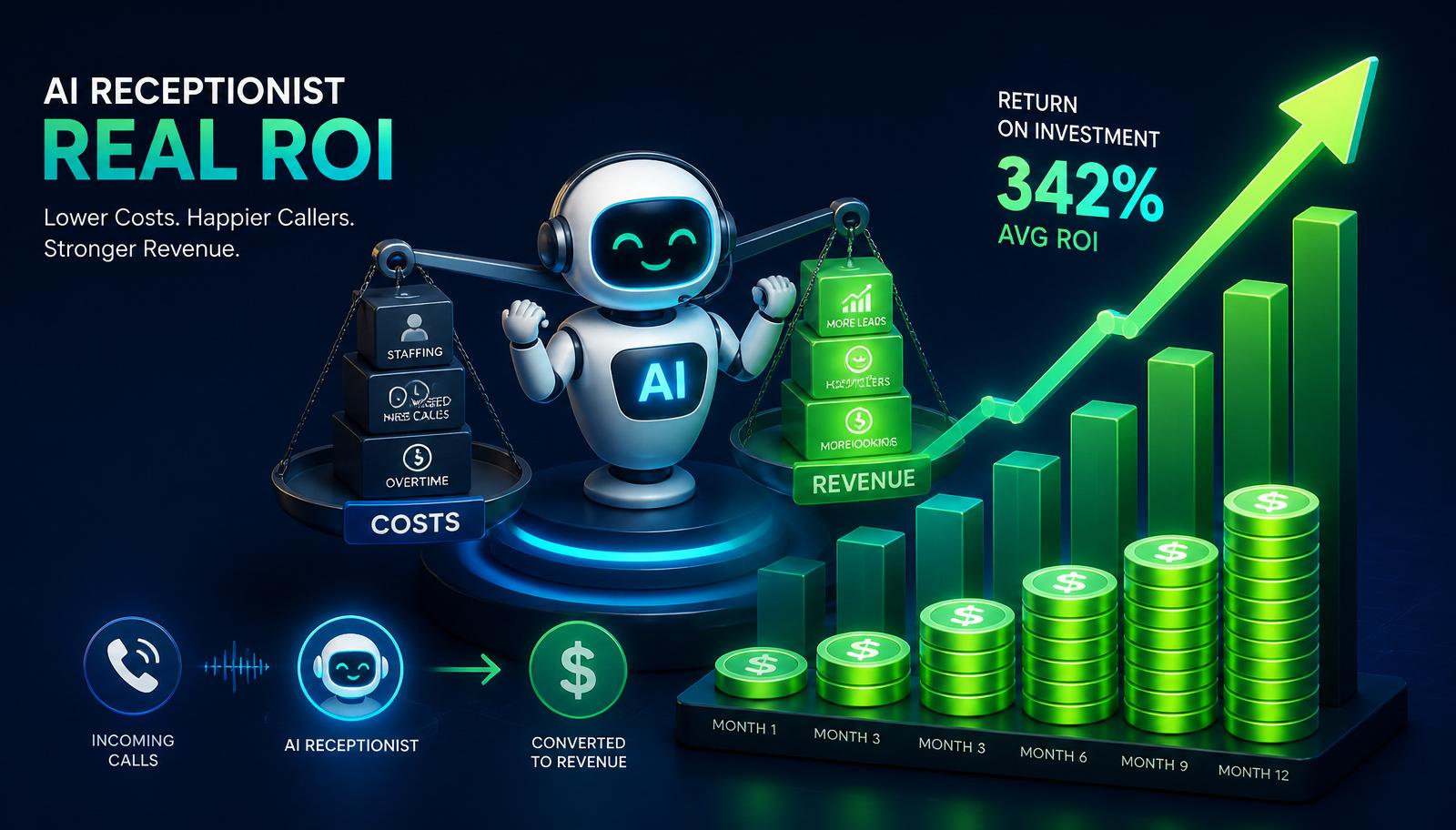
AI Receptionist ROI typically ranges 3x–8x in year one, with payback in 30–90 days.
Decision Framework
Ask yourself six questions:
- 1. Do you miss calls after hours or during peak times? → AI
- 2. Is call volume unpredictable or seasonal? → AI
- 3. Do most calls follow repeatable patterns (booking, FAQs, intake)? → AI
- 4. Do you need a physical greeter at a front desk? → Human
- 5. Are your calls highly emotional or complex? → Human
- 6. Do you want the best of both? → Hybrid
Decision Matrix
- Solo practice, no receptionist yet: AI
- Growing SMB, 1 overwhelmed receptionist: AI + existing human (hybrid)
- Large enterprise, complex calls: hybrid
- Luxury / VIP service: human-led + AI fallback
- After-hours coverage only: AI
- Multilingual customer base: AI
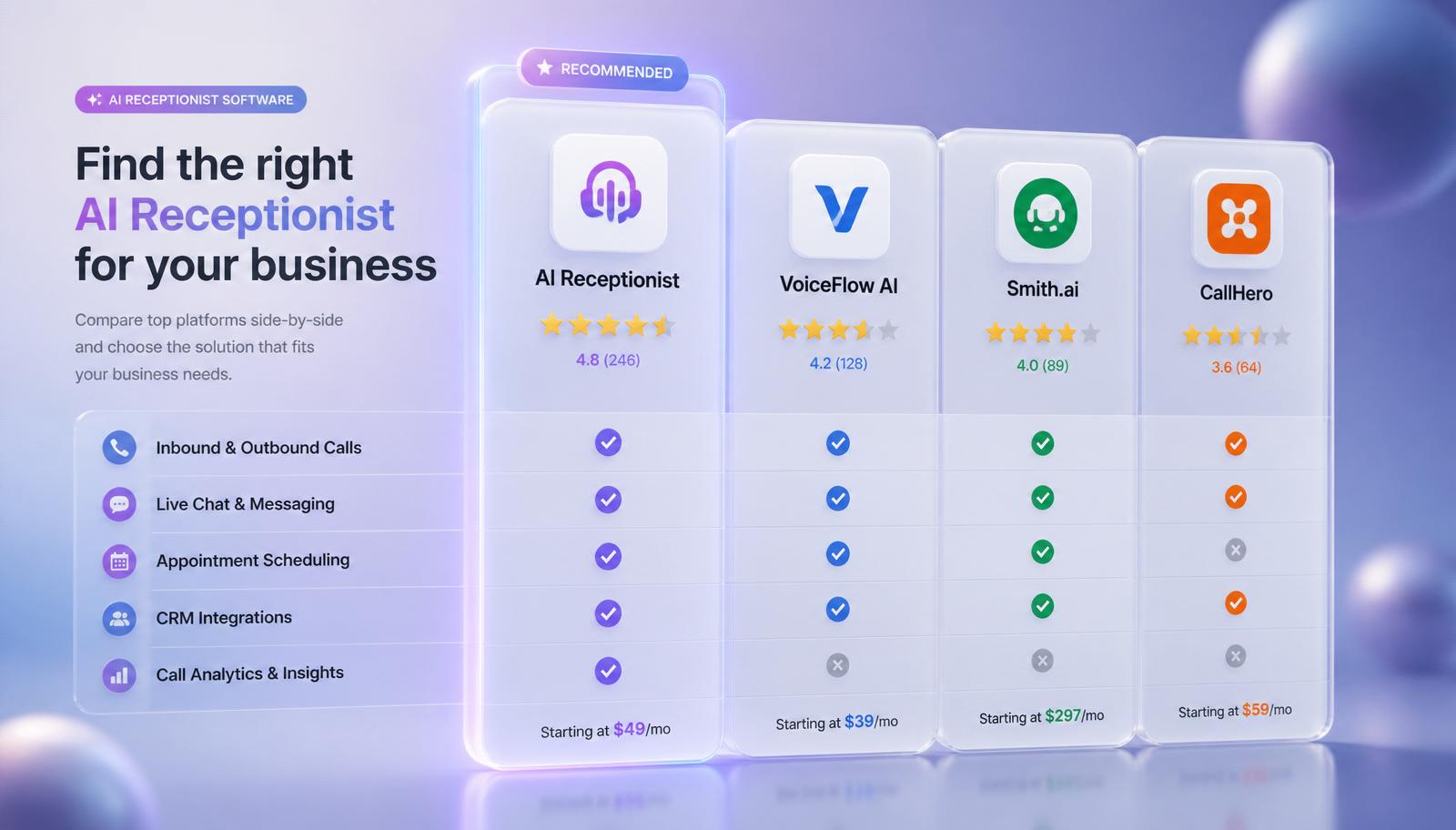
Try a real conversation with our AI on the [live demo](/demo) or explore [AI Receptionist](/services/ai-receptionist) and [AI Voice Agent](/services/ai-voice-agent) services. For deeper vendor evaluation, see [Best AI Receptionist Software](/blog/best-ai-receptionist-software) and model the return in [AI Receptionist ROI](/blog/ai-receptionist-roi).
Who Should Choose AI vs Human vs Hybrid?
Use this decision matrix to pick the right model based on business profile, not marketing hype.
- Solo practitioner / new business (< 100 calls/mo): → AI-only. Cheapest way to never miss a call.
- SMB with 1 overwhelmed receptionist (100–800 calls/mo): → Hybrid. AI takes routine, human takes escalations.
- Multi-location service business (HVAC, dental, real estate): → Hybrid. AI handles dispatch/booking 24/7, humans handle on-site.
- High-empathy service (therapy, hospice, funeral, crisis): → Human-led + AI after-hours. Empathy is the product; AI covers overflow only.
- Enterprise (1,000+ calls/mo, complex routing): → Hybrid at scale. AI as tier-1, humans as tier-2/3.
- Luxury / VIP concierge: → Human-led + AI backup. Human touch is the brand.
- E-commerce / SaaS support: → AI-only. Repeatable questions, high volume, low emotional weight.
- Multilingual customer base: → AI-only or hybrid. One AI replaces multiple bilingual hires.
- Regulated healthcare / legal intake: → Hybrid. HIPAA-compliant AI intakes; human confirms.
Visual Comparison Table
At-a-glance summary of the three models across the seven dimensions that matter most in a buying decision:
- Cost — AI: $ (lowest, $99–$999/mo). Human: $$$ ($3,500–$5,500/mo FTE). Hybrid: $$ ($500–$2,000/mo blended).
- Availability — AI: 24/7/365. Human: 40h/week. Hybrid: 24/7 with human on business hours.
- Speed — AI: sub-second. Human: 15–60 seconds. Hybrid: sub-second (AI answers first).
- Scalability — AI: instant, unlimited. Human: slow, linear (hire + train). Hybrid: instant with human depth.
- Accuracy — AI: 95–99% on structured tasks. Human: 80–90% under load. Hybrid: 97%+ (AI + human QA).
- Customer Experience — AI: consistent, fast. Human: empathetic, warm. Hybrid: best of both — fast *and* empathetic when needed.
- Best For — AI: repeatable, high-volume, after-hours. Human: emotional, VIP, in-person. Hybrid: growing SMBs and enterprises balancing cost and CX.
Verdict: Pure human wins only on empathy. Pure AI wins on every other axis. Hybrid wins overall for most businesses in 2026.
Common Myths About AI Receptionists
Myth 1: "Customers hate talking to AI."
Reality: 73% of callers don't mind AI when it resolves their issue quickly. What customers actually hate is *waiting on hold* and *reaching voicemail* — both of which AI eliminates.
Myth 2: "AI can't handle complex conversations."
Reality: Modern AI Receptionists resolve 70–90% of calls end-to-end. The remaining 10–30% are warm-transferred to a human with a full transcript — the caller never repeats themselves.
Myth 3: "AI Receptionists are only for tech companies."
Reality: Dental clinics, HVAC contractors, real estate brokerages, and law firms are the fastest-growing adopters. Any business with a phone benefits.
Myth 4: "It's too expensive for small businesses."
Reality: Starter plans begin at $99/month — cheaper than a single day of an FTE. Payback is typically 30–90 days.
Myth 5: "AI will replace all human receptionists."
Reality: AI replaces *tasks*, not *roles*. Humans move up the value chain — handling VIP clients, on-site guests, and escalations that machines can't (and shouldn't).
Myth 6: "Setup takes months."
Reality: Most businesses go live in 3–10 days with a modern vendor. See [Best AI Receptionist Software](/blog/best-ai-receptionist-software) for deployment timelines.
Myth 7: "AI Receptionists sound robotic."
Reality: 2026-generation neural voice models are indistinguishable from humans on routine calls. Most callers don't realize until told.
Frequently Asked Questions
AI Overview Quick Answers
Is an AI Receptionist better than a human? For 70–90% of routine calls (bookings, FAQs, intake, after-hours), yes. Humans still win on empathy, VIP handling, and in-person greeting. Most SMBs get the best ROI from a hybrid model.
How much does an AI Receptionist cost vs a human? $99–$999/month for AI vs $3,500–$5,500/month for a full-time human receptionist — roughly 5x to 20x cheaper per year.
Can an AI Receptionist book appointments as well as a human? Yes — often better. AI reads live calendar availability, books directly into Google/Outlook/Calendly, sends confirmations, and never double-books.
Do customers prefer AI or human receptionists? Customers prefer whichever gives them a fast, correct answer. Surveys show 73% don't mind AI for quick issues; 62% still prefer humans for emotional or complex ones.
What is the ROI of switching from a human to an AI Receptionist? Typically 3x–8x in year one with 30–90 day payback. See [AI Receptionist ROI](/blog/ai-receptionist-roi) for detailed models.
Frequently Asked Questions
1. AI Receptionist vs Human Receptionist — which is better in 2026?
For most SMBs, AI is better for cost, speed, and scale; humans are better for empathy and complex cases. A hybrid usually wins.
2. Is an AI Receptionist cheaper than a human receptionist?
Yes — typically 5x to 20x cheaper per year than a full-time employee.
3. Can an AI Receptionist replace a human completely?
For 70–90% of routine calls, yes. For emotionally complex or VIP calls, humans still perform better.
4. Do customers know they are talking to AI?
Modern voice AI is very natural. Best practice is to disclose politely — most customers don't mind if their issue is solved.
5. What is the ROI of an AI Receptionist?
Typically 3x–8x in year one, with payback in 30–90 days.
6. Is an AI Receptionist good for small businesses?
Yes — it's often the single highest-ROI tool a small business can adopt.
7. AI Receptionist vs Virtual Receptionist — what's the difference?
Virtual receptionists are remote humans (shared across clients). AI Receptionists are software agents — cheaper, faster, and always available.
8. Can an AI Receptionist book appointments?
Yes — directly into Google Calendar, Outlook, Calendly, and most practice-management systems.
9. Is an AI Receptionist HIPAA-compliant?
Reputable vendors offer HIPAA, SOC 2, GDPR, and PCI-compliant deployments.
10. Can it integrate with my CRM?
Yes — HubSpot, Salesforce, GoHighLevel, Pipedrive, Zoho, and hundreds more via [n8n Automation](/n8n-automation).
11. What if the AI can't answer?
It warm-transfers to a human or takes a detailed message and creates a follow-up task.
12. How long does setup take?
Most businesses go live in 3–10 days.
13. Can it handle multiple languages?
Yes — 30+ languages, including mid-call switching.
14. Will an AI Receptionist hurt my customer experience?
Done right, it improves CX because callers get instant answers instead of voicemail or hold music.
15. Should I hire a receptionist or use AI first?
Start with AI. Scale to a hybrid model as call complexity grows.
Key Takeaways
- AI Receptionist vs Human Receptionist is no longer either/or — it's about the right mix.
- AI wins on cost, speed, availability, and scale.
- Humans win on empathy, judgment, and physical presence.
- Hybrid is the best model for most SMBs in 2026.
- ROI is fast: 30–90 day payback is typical.
- The businesses that adopt AI Receptionists first will out-book, out-serve, and out-earn competitors that don't.
Conclusion
The AI Receptionist vs Human Receptionist debate is really a debate about how you want to spend your time, money, and human talent. AI handles the repetitive, always-on work. Humans handle the moments that require heart. Together, they let a small business punch far above its weight.
If you're still sending calls to voicemail after 5 p.m., losing leads to competitors, or paying an FTE $60k/year to book appointments — 2026 is the year to fix it.
Ready to See It in Action?
[GetLeadExpo](/services/ai-receptionist) builds custom AI Receptionists and [AI Voice Agents](/services/ai-voice-agent) that answer your calls 24/7, book appointments, qualify leads, and sync everything to your CRM through [n8n Automation](/n8n-automation).
Try the [live AI demo](/demo) or [book a free consultation](/contact) — and see exactly how much time, money, and revenue an AI Receptionist can recover for your business this quarter.
Related reading
- [What Is an AI Receptionist?](/blog/what-is-an-ai-receptionist)
- [AI Receptionist Benefits](/blog/ai-receptionist-benefits)
- [AI Receptionist Pricing Guide](/blog/ai-receptionist-pricing-guide)
Ashikur Rahman
Founder, GetLeadExpo
Writing about B2B lead generation, deliverability, and n8n AI automation at GetLeadExpo.