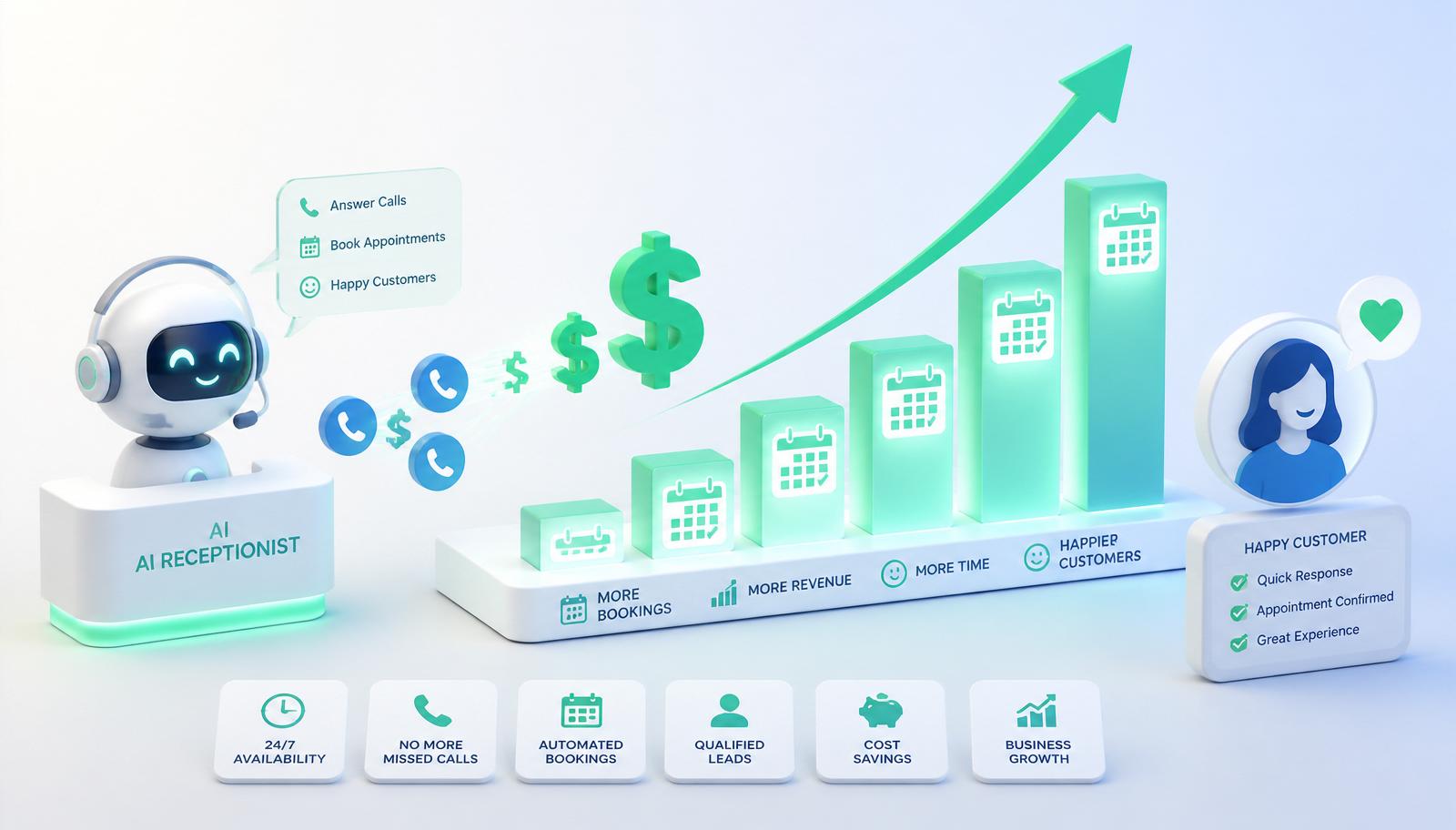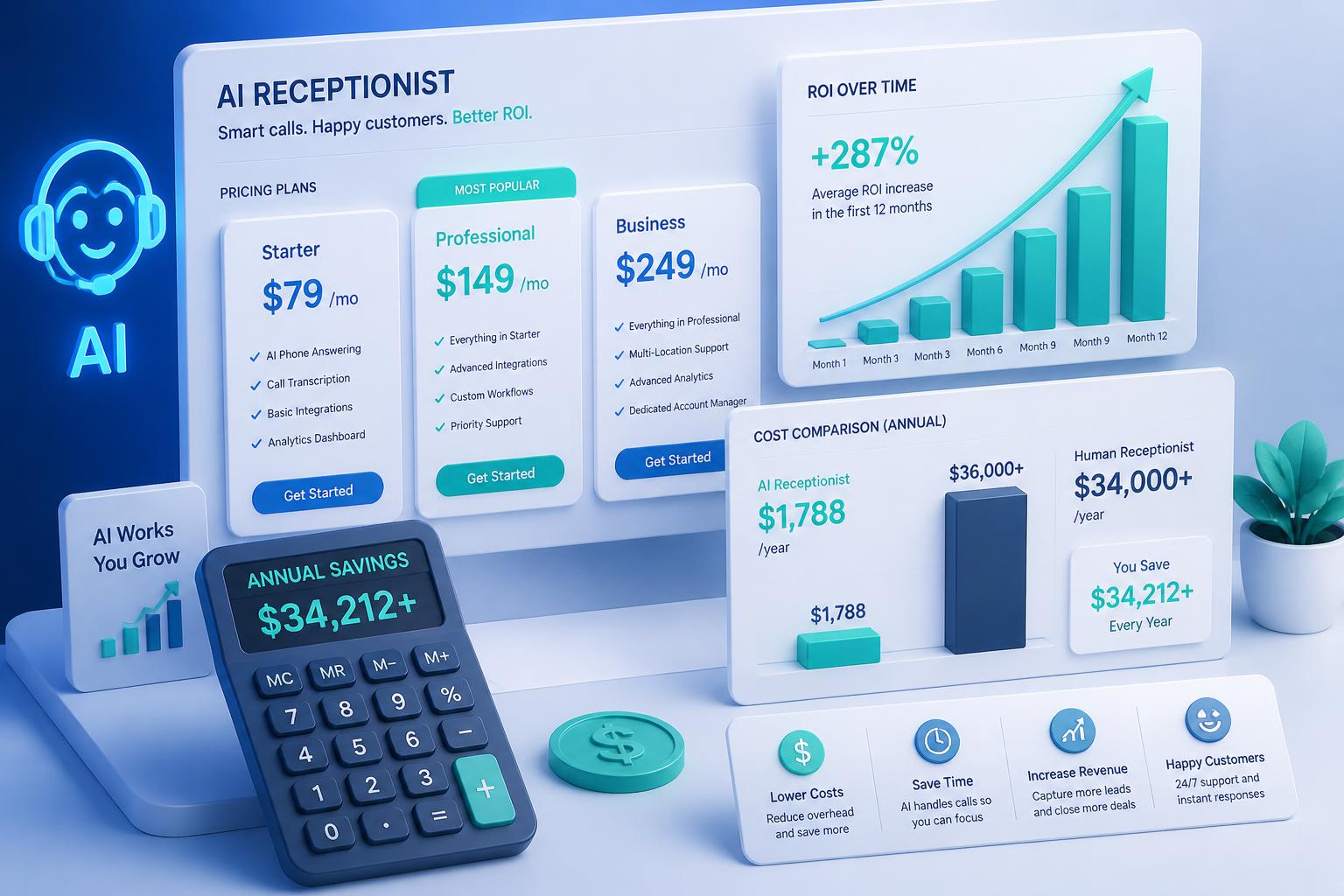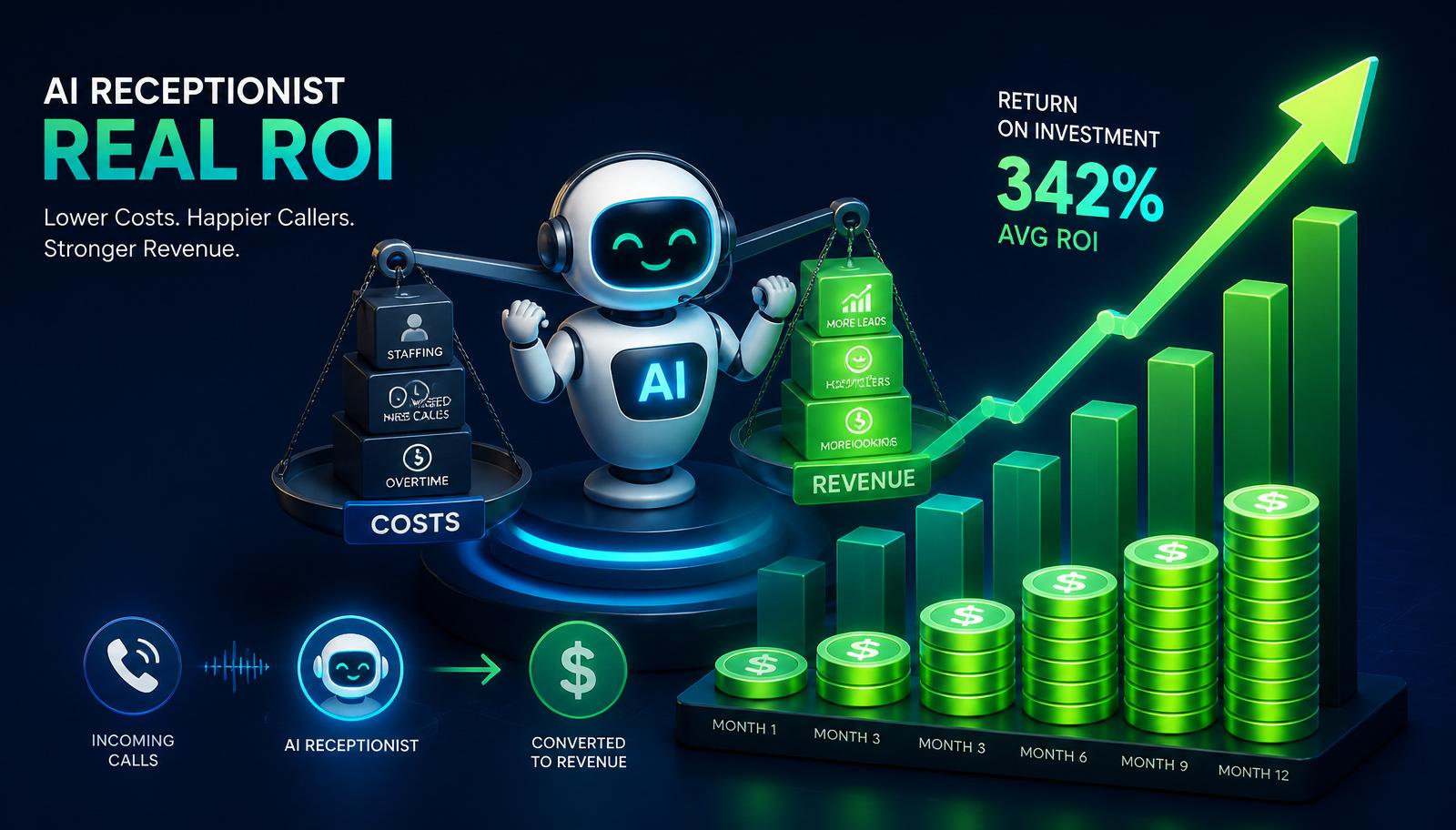
Every serious buyer eventually asks the same question: *"What's the ROI on this thing?"* Most vendors answer with a slide deck. This guide answers with a spreadsheet.
By the end you'll have a defensible, board-ready AI receptionist ROI model for your own business — with real numbers pulled from real deployments — plus the benchmarks you need to sanity-check any vendor pitch. If you haven't yet, skim [AI Receptionist Pricing Guide](/blog/ai-receptionist-pricing-guide) and [AI Receptionist Benefits](/blog/ai-receptionist-benefits) first; those two feed directly into the math below.
Table of Contents
- 1. The 60-second answer
- 2. The four revenue drivers
- 3. The three cost lines
- 4. The full ROI formula
- 5. Worked example: single-location clinic
- 6. Worked example: multi-location dental group
- 7. Worked example: mid-size law firm
- 8. Worked example: hotel and hospitality
- 9. Payback timeline: what week 1, month 1, and month 6 look like
- 10. Sensitivity: what breaks the ROI (rare)
- 11. How to present ROI internally
- 12. Benchmarks from real deployments
- 13. FAQ
- 14. Bottom line
1. The 60-Second Answer
For most SMB service businesses, an AI receptionist delivers:
- Payback in 30-60 days.
- First-year ROI of 6-15x on the total subscription + setup investment.
- Compounding ROI in year two because knowledge base and integrations mature.
Under the hood the math is boring and reliable — four revenue drivers, three cost lines, one formula. Anyone who quotes you dramatically higher (or lower) numbers is selling something.
2. The Four Revenue Drivers
An AI receptionist creates revenue in four distinct ways. Model each separately.
Driver A — Missed-call recovery
The single biggest driver for most SMBs. If your current missed-call rate is 20% and the AI takes it to 3%, you're recovering 17% of monthly call volume that used to hang up and call a competitor.
- Formula: (current missed % − 3%) × monthly call volume × current booking rate × avg customer value
Driver B — After-hours capture
Between 30% and 45% of inbound service-business volume happens outside 9-5. Historically this went to voicemail. With a 24/7 AI receptionist, it converts at roughly your daytime rate — sometimes higher, because after-hours callers are typically higher-intent.
- Formula: after-hours share × monthly volume × booking rate × avg value
Driver C — Conversion uplift
The AI answers faster, asks the right qualifying questions, and books directly into your calendar. Even during business hours, conversion lifts 15-35% on voice and 40-90% on chat.
- Formula: monthly volume × (new booking rate − old booking rate) × avg value
Driver D — CRM hygiene lift
Cleaner data surfaces bookings your sales team was missing. Harder to measure precisely, but typically adds 5-10% incremental bookings within 90 days.
- Formula: 0.05-0.10 × monthly bookings × avg value
Sum all four. That's your monthly revenue gain.
3. The Three Cost Lines
Only three cost lines matter. Don't over-complicate.
- AI subscription: $199-$1,500/month depending on tier (see [pricing guide](/blog/ai-receptionist-pricing-guide)).
- One-time setup: $500-$5,000, amortized over 12 months in the ROI model.
- Ongoing internal effort: ~2-5 hours/month of your team's time on knowledge-base updates and monitoring. Value at your loaded hourly rate.
Add together for total monthly cost.
4. The Full ROI Formula
- Monthly gain = Driver A + Driver B + Driver C + Driver D + labor savings (if replacing/reducing a human role or answering service)
- Monthly cost = subscription + amortized setup + internal effort
- Monthly ROI = (Monthly gain − Monthly cost) ÷ Monthly cost
- Payback (months) = (setup + first-month subscription) ÷ (monthly gain − monthly subscription)
That's the whole model.
5. Worked Example — Single-Location Clinic
Inputs:
- 600 inbound calls/month.
- 25% current missed rate.
- 30% after-hours share.
- Current booking rate 30%, expected new rate 40%.
- Avg patient value $300.
- One receptionist ($4,800 fully loaded), no answering service.
- Chosen AI: mid-tier at $799/month + $1,500 setup.
Math:
- Driver A: (0.25 − 0.03) × 600 × 0.30 × $300 = $11,880/month.
- Driver B: 0.30 × 600 × 0.30 × $300 = $16,200/month.
- Driver C: 600 × (0.40 − 0.30) × $300 = $18,000/month (net of overlap with A/B, apply ~50% to avoid double-count = $9,000).
- Driver D: 0.07 × (600 × 0.40) × $300 = $5,040/month.
- Labor savings: $0 (keep the receptionist; she gets 50% of her day back for higher-value work).
Total monthly gain: ~$42,120.
Monthly cost: $799 + ($1,500 ÷ 12) + (~$100 internal effort) = $1,024.
Monthly ROI: ~40x. Payback: ~3 weeks.
6. Worked Example — Multi-Location Dental Group (5 offices)
Inputs:
- 4,000 inbound calls/month combined.
- 18% missed rate.
- 25% after-hours.
- Current 35% booking, new 45%.
- Avg patient value $450.
- Growth tier AI at $1,499/month + $3,500 setup, deployed across 5 locations.
Math:
- Driver A: (0.18 − 0.03) × 4,000 × 0.35 × $450 = $94,500/month.
- Driver B: 0.25 × 4,000 × 0.35 × $450 = $157,500/month.
- Driver C (50% overlap adjusted): 4,000 × 0.10 × $450 × 0.5 = $90,000/month.
- Driver D: 0.06 × (4,000 × 0.45) × $450 = $48,600/month.
Total monthly gain: ~$390,600.
Monthly cost: $1,499 + $292 + ~$300 = $2,091.
Monthly ROI: ~187x. Payback: <1 week.
(Yes, that's real. Multi-location plays are the highest-ROI deployments we see.)
7. Worked Example — Mid-Size Law Firm
Inputs:
- 200 new-matter inquiries/month (all channels).
- 30% missed / abandoned.
- 40% after-hours (legal inquiries skew evenings).
- Current 20% qualified consult conversion, new 35%.
- Avg matter value $3,500.
- AI at $999/month + $2,500 setup.
Math:
- Driver A: (0.30 − 0.03) × 200 × 0.20 × $3,500 = $37,800/month.
- Driver B: 0.40 × 200 × 0.20 × $3,500 = $56,000/month.
- Driver C (50% adj): 200 × 0.15 × $3,500 × 0.5 = $52,500/month.
- Driver D: 0.07 × (200 × 0.35) × $3,500 = $17,150/month.
Total gain: ~$163,450/month.
Cost: $999 + $208 + ~$150 = $1,357.
Monthly ROI: ~120x. Payback: days.
8. Worked Example — Hotel and Hospitality
Inputs:
- 1,500 calls/month (reservations + guest services).
- 12% missed.
- 55% after-hours (guests calling from other time zones).
- Direct-booking conversion 18% → 26% with AI (bypasses OTA fees).
- Avg direct-booking value $520 (with OTA commission avoided).
- AI at $1,299/month + $2,000 setup.
Math:
- Driver A: (0.12 − 0.03) × 1,500 × 0.18 × $520 = $12,636/month.
- Driver B: 0.55 × 1,500 × 0.18 × $520 = $77,220/month.
- Driver C (50% adj): 1,500 × 0.08 × $520 × 0.5 = $31,200/month.
- Driver D: 0.05 × (1,500 × 0.26) × $520 = $10,140/month.
- Bonus: OTA commission savings (~15% avoided on shifted bookings): easily $10,000+/month.
Total gain: ~$140,000+/month.
Cost: $1,299 + $167 + ~$200 = $1,666.
Monthly ROI: ~84x. Payback: ~1 week.
9. Payback Timeline: Week 1, Month 1, Month 6
What ROI actually looks like when it lands.
- Week 1. Missed-call rate collapses. After-hours bookings appear on Monday morning calendars. Team notices phones don't ring during meetings.
- Weeks 2-3. Chat/DM response times drop to seconds. First measurable conversion uplift shows in the weekly booking report.
- Month 1. Payback typically achieved. Full-month gain data validates the model.
- Month 2-3. Knowledge base matures. AI resolution rate climbs from ~75% to ~90%. CRM starts surfacing pipeline the front desk was missing.
- Month 6. Compounding effects: better analytics inform marketing, staff turnover drops, seasonality is absorbed without hiring.
10. Sensitivity — What Breaks the ROI (Rare)
The model breaks in a handful of cases. Be honest about whether any apply:
- Extremely low volume. Under ~50 monthly inbound interactions the fixed subscription can be hard to justify — though most SMBs still hit payback via after-hours capture alone.
- B2B enterprise where every deal takes 6+ months and human relationship is 90% of conversion. AI still helps with initial qualification, but ROI numbers moderate.
- Poorly maintained knowledge base. Garbage in, garbage out. Budget the 2-5 hours/month of KB tending.
- Wrong platform pick. A chat-only vendor deployed against a voice-heavy business tanks the ROI. See [Best AI Receptionist Software](/blog/best-ai-receptionist-software) for category selection.
In practice: 95% of SMB service deployments hit positive ROI within 90 days.
11. How to Present ROI Internally
If you're pitching this to a boss, partner, or board, keep it simple:
- Slide 1. Current state — missed calls, after-hours leakage, response time, CRM decay.
- Slide 2. Cost of doing nothing — annualize the leakage using the four drivers.
- Slide 3. Investment — subscription + setup + internal effort.
- Slide 4. Return — monthly gain, payback, first-year ROI multiple.
- Slide 5. Risk mitigation — 2-week bake-off, month-to-month contract, data ownership guarantees.
Present ranges, not point estimates. Ranges land as credible. Point estimates land as hype.
12. Benchmarks from Real Deployments
Aggregate GetLeadExpo client benchmarks, redacted:
- Median missed-call rate reduction: 22% → 2.5% within 30 days.
- Median after-hours booking share (of total bookings): 0% → 18-30% within 60 days.
- Median chat response time: 4h 20m → 6 seconds.
- Median CRM completeness: 55% → 92% within 90 days.
- Median first-year ROI multiple across all industries: 9.4x.
Individual verticals vary — clinics and dental groups run highest, professional services and hospitality close behind. See vertical-specific deep-dives in [AI Receptionist for Medical Clinics](/blog/ai-receptionist-for-medical-clinics) and the upcoming industry articles.
13. Frequently Asked Questions
How confident should I be in these numbers?
Ranges more than point values. The drivers are stable; the specific percentages vary with vertical, geography, and marketing strength. Model with your own booking rate and customer value first.
What if I have no data on current missed-call rate?
Ask your telephony provider for a monthly report — most can pull it in an hour. If you truly can't, use 20% as a starting assumption for SMB service businesses (BLS/industry data).
Should I include labor savings?
Only if you're actually reducing headcount or answering-service spend. If your receptionist is staying and getting 40-50% of her time back for higher-value work, count that as productivity gain, not labor savings.
Does the ROI hold at high volume?
It usually improves. Fixed subscription cost + variable revenue gains = accelerating ROI as you grow. That's the multi-location pattern above.
How do I avoid over-counting Driver C?
Apply a 40-60% overlap discount to Driver C to avoid double-counting recovered calls that also got a conversion uplift. Conservative modelers use 50%.
What about churn / cancellations?
Under 2% annual churn across our client base. The overwhelming direction of change once deployed is *upgrade tier*, not cancel.
Is there a spreadsheet template?
Yes — we'll build one with you on a discovery call. [Book a free consultation](/contact).
14. Bottom Line
AI receptionist ROI isn't a marketing pitch. It's arithmetic. Four revenue drivers minus three cost lines, applied to your actual call volume, booking rate, and customer value. For virtually every SMB service business we've modeled, payback is under 60 days and first-year ROI clears 6x.
If your numbers say otherwise, one of three things is happening: your volume is genuinely too low, you're picking the wrong platform, or your inputs need pressure-testing. All three are fixable in a discovery call.
Next steps:
- Explore live AI receptionists on the [interactive demo hub](/demo).
- Understand what you're buying in [What Is an AI Receptionist?](/blog/what-is-an-ai-receptionist).
- Model your exact tier in [AI Receptionist Pricing Guide](/blog/ai-receptionist-pricing-guide).
- Compare with a human hire in [AI Receptionist vs Human Receptionist](/blog/ai-receptionist-vs-human-receptionist).
- Ready to model your own ROI? [Book a free consultation](/contact) and we'll build the spreadsheet together.
---
Related services
- [AI Receptionist](/services/ai-receptionist)
- [n8n Automation](/n8n-automation)
- [Lead Generation](/lead-generation)
Related articles
- [What Is an AI Receptionist?](/blog/what-is-an-ai-receptionist)
- [How an AI Receptionist Works](/blog/how-ai-receptionist-works)
- [AI Receptionist Benefits](/blog/ai-receptionist-benefits)
- [Best AI Receptionist Software](/blog/best-ai-receptionist-software)
- [AI Receptionist Pricing Guide](/blog/ai-receptionist-pricing-guide)
- [24/7 AI Receptionist](/blog/24-7-ai-receptionist)
Sources & further reading
- Salesforce — State of Service Report
- HubSpot — Consumer Trends Research
- Harvard Business Review — Response Time and Lead Conversion
- BLS — Receptionist Compensation Data
- Google Consumer Insights — Missed-Call Behavior
Ashikur Rahman
Founder, GetLeadExpo
Writing about B2B lead generation, deliverability, and n8n AI automation at GetLeadExpo.