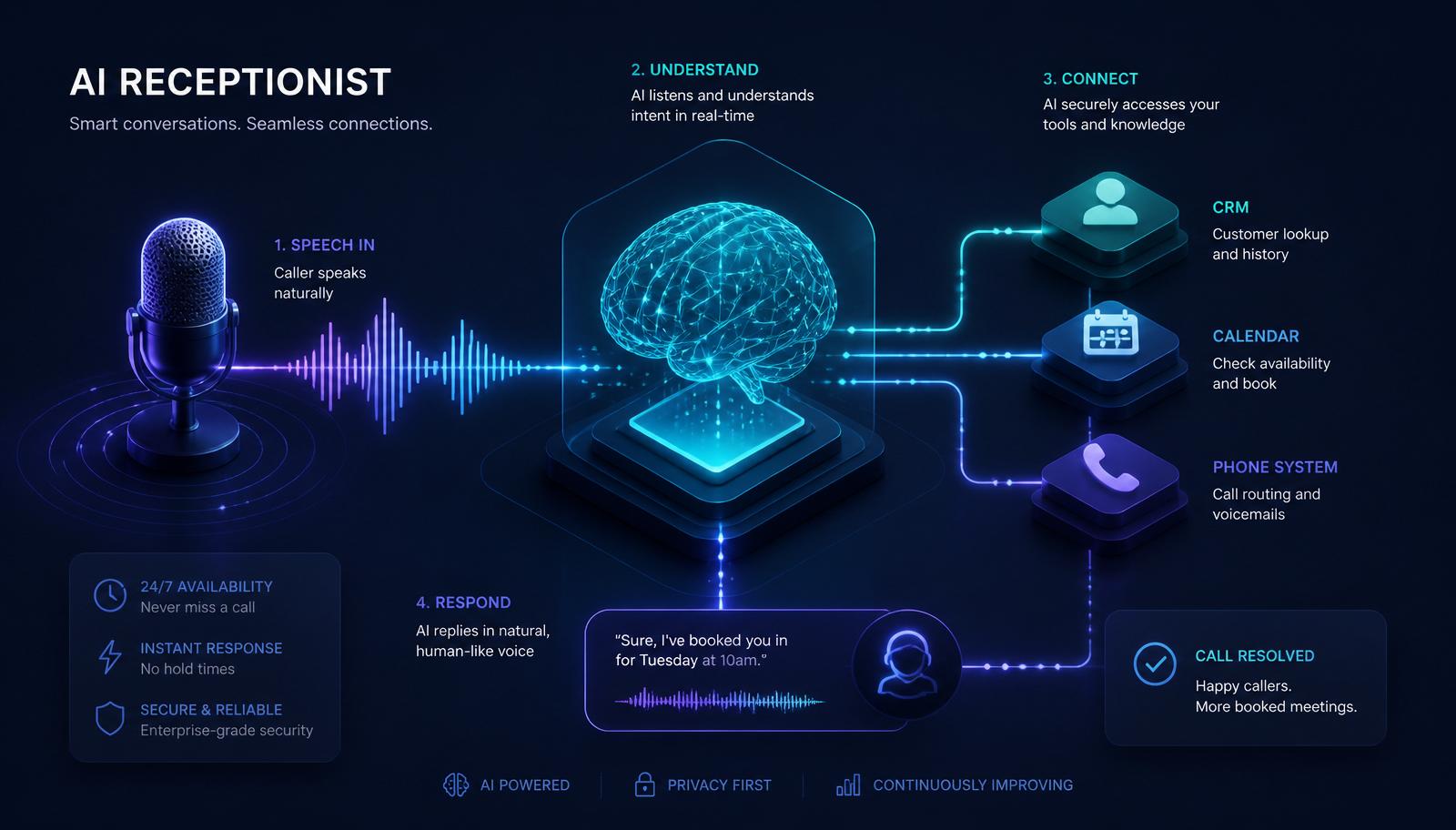
Every AI receptionist vendor claims the same thing on the homepage: "answers calls, books meetings, works 24/7." That description covers about 40% of what actually decides whether the software earns its keep. The other 60% is buried in the docs — and it's where deployments succeed or quietly fail.
This is the operator's checklist we use with GetLeadExpo clients. Twenty-five features grouped into the seven capability areas that matter, ranked by how often the missing one is the reason a shortlisted vendor gets cut. If you're still choosing a platform, pair this with [Best AI Receptionist Software](/blog/best-ai-receptionist-software) and [AI Receptionist Pricing Guide](/blog/ai-receptionist-pricing-guide). If you're earlier in the buying cycle, [What Is an AI Receptionist?](/blog/what-is-an-ai-receptionist) and [How an AI Receptionist Works](/blog/how-ai-receptionist-works) cover the fundamentals.
Table of Contents
- 1. How to read a feature list without getting fooled
- 2. Voice & conversation features (1–6)
- 3. Scheduling & booking features (7–10)
- 4. Routing, escalation & handoff (11–14)
- 5. Data capture & CRM features (15–18)
- 6. Multichannel & language features (19–21)
- 7. Analytics, QA & compliance (22–25)
- 8. Features that sound impressive but don't matter
- 9. A 25-point evaluation scorecard
- 10. FAQs
1. How to read a feature list without getting fooled
Vendor feature pages optimize for checkbox parity, not real behaviour. Three rules keep you honest:
1. "Supports" ≠ "does well." Every platform "supports" calendar booking. Half of them can't reschedule across time zones without a human touching it. 2. Ask for the failure mode. "What does it do when the caller asks something off-script?" is a more useful question than "does it have an FAQ knowledge base?" 3. Demo with your own worst call. Take the ugliest voicemail from last month, replay it into the demo, and watch what happens. Feature lists lie. Recordings don't.
With that filter in mind, here are the 25 features that actually move the needle.
2. Voice & conversation features (1–6)
The single biggest quality gap between AI receptionists in 2026 is voice — how the agent sounds, how it handles interruptions, and how gracefully it recovers when a caller goes off-script. Get these six right and 80% of complaints disappear.
Feature 1 — Sub-800ms response latency
Human turn-taking sits around 200ms. Anything over one second feels robotic. Modern voice-first platforms (voice-native architectures, not chatbots strapped to a phone number) hit 500–800ms round-trip. If a vendor won't quote a latency number, that's your answer.
Feature 2 — Barge-in / interruption handling
The caller starts talking mid-sentence and the agent stops, listens, and responds to the new intent — not the old one. Without barge-in, the experience feels like an old IVR. Test this on every demo: interrupt the agent three times in a row.
Feature 3 — Natural prosody and voice cloning options
Newer TTS engines (ElevenLabs, PlayHT, OpenAI, native provider voices) produce speech with breath, emphasis, and non-verbal cues. A subset lets you clone a specific voice (owner, front-of-house lead) so the AI matches your brand. Optional, but powerful for hospitality and healthcare.
Feature 4 — Noise robustness
Callers phone from cars, cafés, construction sites, and hospital corridors. Ask the vendor which ASR engine they run and whether it's tuned for telephony audio (8kHz narrowband) or trained on studio recordings. The difference in transcription accuracy on real calls is 15–25 percentage points.
Feature 5 — Multi-turn context and memory
The agent remembers what the caller said 30 seconds ago and doesn't ask for the same information twice. If the caller says "I'm calling about my son's appointment on Thursday," the agent shouldn't then ask "and whose appointment is this for?" This is table stakes in 2026 — but not every vendor delivers it.
Feature 6 — Graceful "I don't know" behaviour
When the caller asks something outside the knowledge base, the agent should acknowledge, offer a next step (message, callback, human transfer), and not hallucinate an answer. Vendors that let the LLM freewheel without a safety layer will happily invent policies, prices, and appointment slots that don't exist.
3. Scheduling & booking features (7–10)
For most SMBs, booking is the reason they bought an AI receptionist. Getting the scheduling stack right is worth more than any other capability.
Feature 7 — Real-time calendar availability
The agent checks live availability against Google Calendar, Outlook, Calendly, Cal.com, Nexhealth, or the practice-management system — not a cached copy. Cached availability leads to double bookings within 48 hours of go-live.
Feature 8 — Multi-provider / multi-resource booking
Any business with more than one bookable person or resource (dentist + hygienist, room + technician, stylist + chair) needs the agent to book against the right combination, not just the first available slot. This is where 60% of dental and salon deployments break down.
Feature 9 — Timezone-aware rescheduling and cancellations
The agent can find an existing appointment by phone number or name, offer alternative slots in the caller's timezone, and cancel with a confirmation. Bonus points for enforcing your cancellation policy (24-hour notice, deposit forfeit) automatically.
Feature 10 — Confirmation and reminder workflow
After booking, the agent triggers SMS + email confirmations, adds the event to the customer's calendar, and schedules reminders 24 hours and 2 hours before. Missing this step alone drives 8–15% no-show rates.
4. Routing, escalation & handoff (11–14)
An AI receptionist that can't escalate is a liability. The features here decide what happens when things go wrong — which they will.
Feature 11 — Warm transfer to a live human
Not a cold transfer that dumps the caller into a queue. A warm transfer where the agent briefs the human ("caller is Mrs Nolan, existing patient, calling about a filling that came out yesterday") in text or audio before connecting. This is the single feature that turns a good AI receptionist into one your team trusts.
Feature 12 — Rules-based routing (department, VIP, geography, hours)
The agent routes based on caller ID, spoken intent, and business rules — not a menu tree. VIP customers go straight to a named human. After-hours emergencies page the on-call. Non-English speakers route to the bilingual line. If the vendor can only route by menu number, that's a 2015 IVR wearing a 2026 skin.
Feature 13 — Fallback to voicemail with transcription
When no human is available, the agent takes a structured message (name, callback number, reason, urgency), transcribes it, and drops it into the correct channel — email, Slack, CRM task. This is the safety net that lets you deploy 24/7 confidently.
Feature 14 — Emergency detection and override
The agent detects urgency cues ("chest pain", "flooding", "break-in") and overrides normal flow to page the on-call human, dial 911, or route to the emergency line. Every serious healthcare and property-management vendor has this; verify the exact trigger list.
5. Data capture & CRM features (15–18)
The AI receptionist is the highest-volume data-entry job in your business. If the captured data doesn't land cleanly in your systems, you're getting half the value.
Feature 15 — Native CRM integrations (HubSpot, Salesforce, Pipedrive, Zoho, GoHighLevel)
Native = pre-built, maintained by the vendor, updated when the CRM's API changes. Native beats "we support Zapier" every time. Verify the specific object mappings: contact + call log + task + note, at minimum.
Feature 16 — Structured field extraction
The agent pulls named fields — appointment reason, insurance provider, preferred contact time, budget range — into typed CRM fields, not a blob of transcript. Without structured extraction, sales and ops teams stop reading AI receptionist output within two weeks.
Feature 17 — Duplicate detection and contact merging
When a returning caller phones from a new number, the agent matches on name + previous appointment + address rather than creating a duplicate contact. This is the difference between a clean CRM and one that has to be re-imported every quarter.
Feature 18 — Webhook / API access
For anything the native integrations don't cover, a webhook fires on call-end with the full structured payload. Combined with a workflow engine like n8n, this unlocks custom routing, downstream automations, and internal dashboards. See [Building AI Agents With n8n](/blog/building-ai-agents-with-n8n) for the pattern.
6. Multichannel & language features (19–21)
Voice-only is a shrinking segment. Buyers under 40 default to text. If your AI receptionist can't move between channels, half your inbound is losing context on every handoff.
Feature 19 — Voice + SMS + web chat + email in one thread
One conversation follows the customer across channels. Started on the phone, continued via SMS follow-up, closed in web chat — same thread, same context, same agent memory. Vendors that treat each channel as a separate product force you to reconcile threads manually.
Feature 20 — Multilingual support (real, not marketing)
"Supports 30+ languages" is meaningless. What matters is: which languages have full parity (ASR + LLM + TTS + booking flows), which are English-only reasoning under a translation layer (worse quality), and which can auto-detect from the first two seconds of speech. For clinics, hotels, and retail, Spanish, French, and Mandarin parity is usually the real requirement.
Feature 21 — Outbound calling and follow-ups
The agent can call back missed calls, confirm bookings, run recovery outreach, and follow up on quotes — not just answer inbound. This doubles the ROI of the same subscription and turns the receptionist into a light SDR.
7. Analytics, QA & compliance (22–25)
You cannot manage what you cannot see. The last four features decide whether the deployment gets better over time or plateaus.
Feature 22 — Full call transcripts + searchable log
Every call, transcribed and searchable, with tags (intent, outcome, sentiment, escalated y/n). Bonus: side-by-side audio + transcript playback for QA review.
Feature 23 — Business metrics dashboard
Not just "calls handled" — appointments booked, revenue attributed, leads captured, escalation rate, average handle time, containment rate, no-show rate. If the dashboard doesn't show revenue, you'll fight to justify renewal. See [AI Receptionist ROI](/blog/ai-receptionist-roi) for the numbers to demand.
Feature 24 — Prompt / knowledge-base versioning
Every change to the agent's instructions, FAQs, and scripts is versioned with a diff and a rollback. Without versioning, "who changed the pricing script last Tuesday" becomes an unanswerable question.
Feature 25 — HIPAA / PCI / GDPR posture
Healthcare vendors need BAAs. Payment-adjacent vendors need PCI DSS. EU buyers need GDPR-compliant data residency. This is a hard gate — no amount of great voice quality substitutes for a signed BAA when you're a clinic.
8. Features that sound impressive but don't matter
Vendors love to lead with these. Politely nod and move on:
- "1000+ languages." Only 8–12 have real production parity.
- "Sub-100ms latency." Marketing measurement, not real-world. 500–800ms is the honest floor.
- "Trained on 10 billion calls." Corpus size doesn't fix your specific domain; retrieval and prompting do.
- "Custom voice cloning included." Rarely used, often just a checkbox.
- "Emotion detection." Interesting demo, minimal operational impact for SMBs.
- "Agentic self-improvement." The agent doesn't secretly get better on its own. Improvement comes from your prompt and knowledge-base edits.
9. A 25-point evaluation scorecard
Print this. Bring it to every demo. Score each vendor 0–2 (0 = missing, 1 = partial, 2 = solid). Anything under 35/50 gets cut.
Voice & conversation (12 points)
- [ ] Sub-800ms latency (0–2)
- [ ] Barge-in / interruption (0–2)
- [ ] Natural prosody (0–2)
- [ ] Noise robustness on telephony (0–2)
- [ ] Multi-turn memory (0–2)
- [ ] Graceful unknown-intent handling (0–2)
Scheduling & booking (8 points)
- [ ] Real-time calendar availability (0–2)
- [ ] Multi-provider / multi-resource (0–2)
- [ ] Timezone-aware reschedule/cancel (0–2)
- [ ] Confirmation + reminder workflow (0–2)
Routing & escalation (8 points)
- [ ] Warm transfer with brief (0–2)
- [ ] Rules-based routing (0–2)
- [ ] Voicemail + transcription fallback (0–2)
- [ ] Emergency detection & override (0–2)
Data & CRM (8 points)
- [ ] Native CRM integrations (0–2)
- [ ] Structured field extraction (0–2)
- [ ] Duplicate detection (0–2)
- [ ] Webhook / API access (0–2)
Multichannel & language (6 points)
- [ ] Voice + SMS + web + email in one thread (0–2)
- [ ] Real multilingual parity (0–2)
- [ ] Outbound calling (0–2)
Analytics & compliance (8 points)
- [ ] Full transcripts + searchable log (0–2)
- [ ] Revenue-level dashboard (0–2)
- [ ] Prompt / KB versioning (0–2)
- [ ] Compliance posture (HIPAA/PCI/GDPR) (0–2)
Total: ___ / 50
35+ = shortlist. 40+ = strong candidate. 45+ = category leader.
10. FAQs
What are the most important AI receptionist features?
The three that predict deployment success most reliably are (a) warm human transfer, (b) real-time calendar availability with multi-resource booking, and (c) structured CRM field extraction. Everything else is quality-of-life; those three are load-bearing.
Do I need every feature on this list?
No. A single-provider clinic doesn't need multi-provider booking. A pure B2B firm doesn't need multilingual parity. Score against your actual business — but be honest about the ones you *think* you don't need until you go live.
How do AI receptionist features compare to a human receptionist?
Humans win on empathy, judgement, and complex problem-solving. AI wins on availability, speed, consistency, and data capture at volume. The right question isn't "which is better" but "which mix." Most successful deployments run AI as the front door and humans as the escalation path — see [AI Receptionist vs Human Receptionist](/blog/ai-receptionist-vs-human-receptionist) for the trade-off in detail.
Which features cost extra vs come standard?
Voice cloning, outbound calling, multilingual (beyond English), custom integrations, and elevated compliance tiers (HIPAA, PCI) are the five features most commonly gated behind higher plans or add-on fees. Budget accordingly and see [AI Receptionist Pricing Guide](/blog/ai-receptionist-pricing-guide) for the fee structures to expect.
Do custom-built AI receptionists have more features?
Yes and no. Custom builds on stacks like n8n + Vapi + Twilio + your CRM can implement any feature listed here, plus business-specific ones. But you also inherit the maintenance burden. For 80% of SMBs the off-the-shelf feature set is enough; for the 20% with unusual workflows, custom pays back within a year. See [Building AI Agents With n8n](/blog/building-ai-agents-with-n8n).
Ready to see these features in action?
If you'd rather score a real deployment than a demo, GetLeadExpo builds AI receptionists on top of the exact 25-feature checklist above — voice-first, CRM-integrated, and wired into an n8n backbone so the capability list keeps growing without a re-platform.
<presentation-actions> <presentation-link url="/services/ai-receptionist">Explore the AI Receptionist service</presentation-link> <presentation-link url="/demo">Book a live demo</presentation-link> </presentation-actions>
Related services
- [AI Receptionist](/services/ai-receptionist)
- [n8n Automation](/n8n-automation)
- [Lead Generation](/lead-generation)
Related articles
- [What Is an AI Receptionist?](/blog/what-is-an-ai-receptionist)
- [How an AI Receptionist Works](/blog/how-ai-receptionist-works)
- [AI Receptionist Benefits](/blog/ai-receptionist-benefits)
- [Best AI Receptionist Software](/blog/best-ai-receptionist-software)
- [AI Receptionist Pricing Guide](/blog/ai-receptionist-pricing-guide)
- [AI Receptionist ROI](/blog/ai-receptionist-roi)
- [AI Receptionist vs Human Receptionist](/blog/ai-receptionist-vs-human-receptionist)
- [24/7 AI Receptionist](/blog/24-7-ai-receptionist)
Sources & further reading
- Vendor documentation across voice-first AI platforms (2026)
- ElevenLabs, PlayHT, OpenAI TTS technical specifications
- HIPAA, PCI DSS, GDPR compliance frameworks
- GetLeadExpo deployment benchmarks across 40+ SMB clients
Ashikur Rahman
Founder, GetLeadExpo
Writing about B2B lead generation, deliverability, and n8n AI automation at GetLeadExpo.