Every quarter, the AI receptionist space looks different. This is the honest, non-vendor version of what is actually shifting in 2026 — 15 trends we see across GetLeadExpo deployments, market data from the top voice platforms, and buyer conversations across clinics, law firms, hotels, home services, and multi-location retail.
If you are early in the buying cycle, start with [What Is an AI Receptionist?](/blog/what-is-an-ai-receptionist) and [AI Receptionist Buyer Guide](/blog/ai-receptionist-buyer-guide). If you are deciding what to build, [How To Build An AI Receptionist](/blog/how-to-build-an-ai-receptionist) covers the reference architecture.
Table of Contents
- 1. Voice-native architectures replace chatbot-on-a-phone
- 2. Sub-800ms latency becomes table stakes
- 3. Vertical specialists overtake horizontal platforms
- 4. Per-minute pricing compresses toward outcome-based
- 5. Warm human handoff becomes the #1 evaluation criterion
- 6. Agentic post-call workflows go mainstream
- 7. Multilingual parity (not "supports 50 languages") wins deals
- 8. Multichannel threading kills the standalone chatbot
- 9. BYO-inference for high-volume buyers
- 10. Compliance moves from feature to gate
- 11. Prompt versioning becomes a procurement requirement
- 12. Outbound eats a slice of the SDR budget
- 13. Vertical benchmark dashboards replace generic analytics
- 14. Deployment time compresses to 3–10 days
- 15. The GPT-wrapper wave collapses
- 16. What to do with these trends
- 17. FAQs
1. Voice-native architectures replace chatbot-on-a-phone
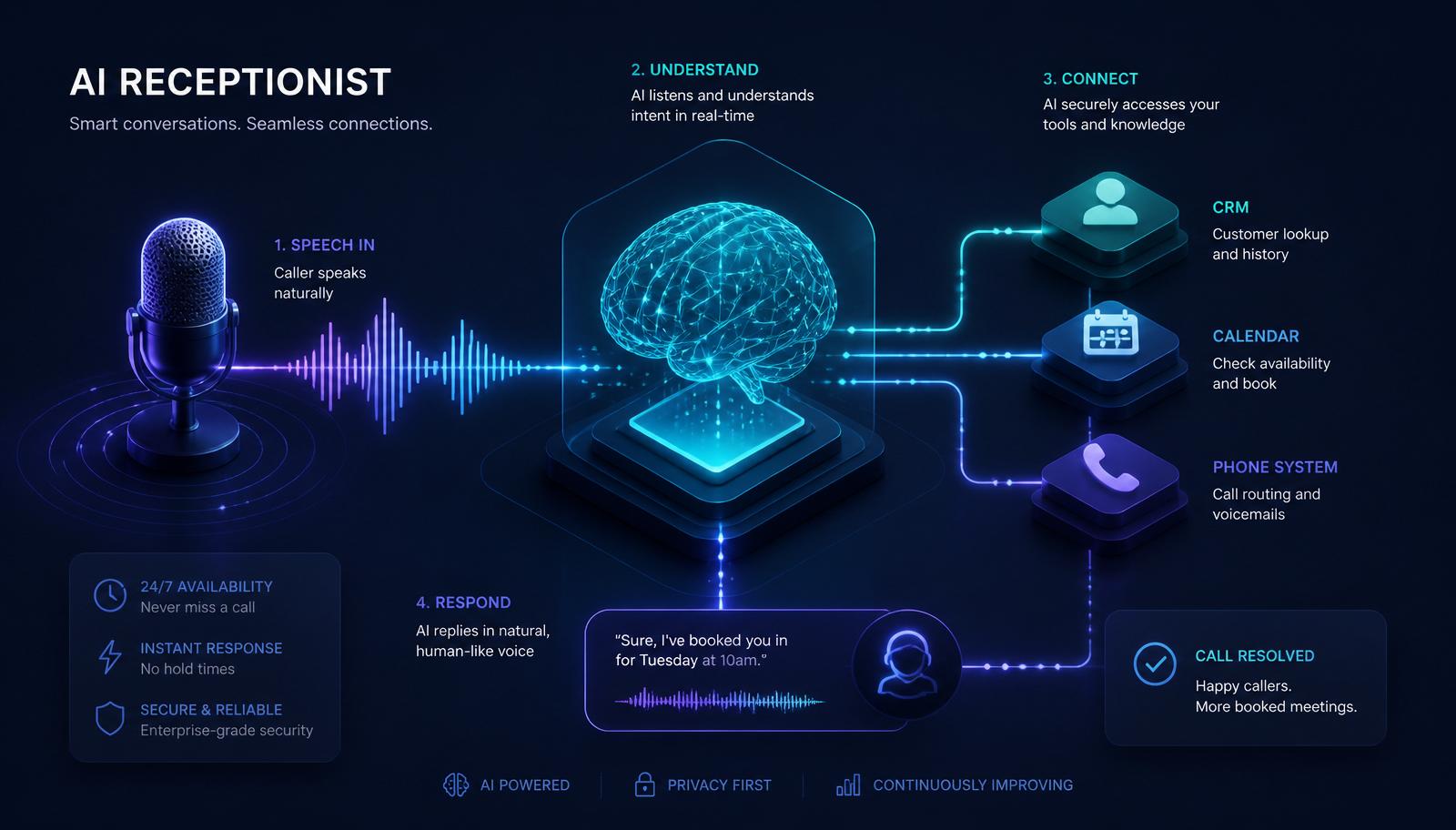
Two years ago most "AI phone agents" were text chatbots with a TTS layer bolted on. In 2026 the top platforms are voice-native — designed around streaming ASR, streaming LLM, streaming TTS, and turn-taking as first-class citizens. The user-experience gap between the two categories is now obvious in a 30-second demo.
Buyer impact: if a vendor's architecture diagram still shows "chat engine → TTS", skip.
2. Sub-800ms latency becomes table stakes
Round-trip latency (caller stops speaking → agent starts speaking) has crashed. In 2024 the average was 1.5–3 seconds. In 2026 leaders sit at 500–800ms and the perceptual gap with humans is nearly gone.
Buyer impact: ask every vendor for their production P50 and P95. Anyone over 1.2s in production is a generation behind.
3. Vertical specialists overtake horizontal platforms
The first wave was won by horizontal tools (one product for every industry). The second wave is being won by verticals — dental-only, law-only, hospitality-only — because they ship pre-built PMS/EHR/booking integrations, industry-tuned prompts, and analytics that speak the industry's KPI language.
Buyer impact: shortlist at least two vertical specialists in your industry alongside the horizontal leaders.
4. Per-minute pricing compresses toward outcome-based
Inference cost has dropped ~10x every 18 months for two years. Per-minute pricing is starting to look as archaic as per-SMS billing. Three replacements are consolidating: flat per-seat/per-location, outcome-based (per booked appointment / per qualified lead), and BYO-inference for enterprises. See [AI Receptionist Pricing Guide](/blog/ai-receptionist-pricing-guide).
Buyer impact: insist on annual repricing clauses on any multi-year contract.
5. Warm human handoff becomes the #1 evaluation criterion
Two years ago buyers led with "how good is the voice?" In 2026 the first serious question in every RFP is "how does escalation work?" The reason: teams have learned that a 90% containment agent with bad handoff is worse than an 80% containment agent with great handoff.
Buyer impact: score handoff (transfer brief, routing rules, voicemail fallback) as heavily as voice quality itself. See [AI Receptionist Features](/blog/ai-receptionist-features).
6. Agentic post-call workflows go mainstream
The agent no longer just books the appointment and drops a note in the CRM. It runs the whole downstream flow: insurance verification, intake forms, deposit reminders, calendar sync, review request three days later. n8n and similar workflow engines are the connective tissue. See [Building AI Agents With n8n](/blog/building-ai-agents-with-n8n).
Buyer impact: the ROI calculation now includes the automation *after* the call, not just the call itself.
7. Multilingual parity (not "supports 50 languages") wins deals
"Supports 50 languages" is meaningless when 45 of them are English-reasoning under a translation layer. What actually matters is *parity* — full-stack ASR + LLM + TTS + booking flows in your target languages. In the US, Spanish parity is the single fastest-growing procurement requirement.
Buyer impact: test the vendor in the exact language your customers actually call in. Ask a native speaker to grade the recording.
8. Multichannel threading kills the standalone chatbot
The standalone website chat bubble is a shrinking category. Buyers now want one agent, one memory, one conversation across voice, SMS, web, WhatsApp, and email. Vendors selling a single channel are getting squeezed.
Buyer impact: if your call volume overlaps with your chat volume, buy the threaded multichannel platform, not two separate tools.
9. BYO-inference for high-volume buyers
Enterprises with negotiated OpenAI / Anthropic / Google contracts increasingly want to point the receptionist at their own inference endpoint. Top platforms now support it; the middle tier is scrambling.
Buyer impact: relevant only above ~50,000 minutes/month, but a strong lever when it applies.
10. Compliance moves from feature to gate
HIPAA BAAs, PCI DTMF, GDPR data residency — these were "nice to have" checkboxes in 2024. In 2026 they are hard gates. Buyers in healthcare, finance, and EU-served markets cut vendors on compliance before any other criterion.
Buyer impact: get compliance evidence (signed BAA sample, SOC 2 report) in Stage 3 qualifying calls, not at contract signing.
11. Prompt versioning becomes a procurement requirement
"Who changed the pricing script last Tuesday?" used to be an unanswerable question. Buyers now demand git-style versioning on every prompt, knowledge chunk, and script — with diffs, rollback, and audit trails.
Buyer impact: if the vendor's admin panel doesn't show version history, it does not scale beyond one office.
12. Outbound eats a slice of the SDR budget
The same agent that answers inbound calls now makes outbound ones — reminder calls, no-show recovery, quote follow-ups, past-customer reactivation. Fully TCPA-compliant with time-window rules, DNC scrubbing, and opt-out handling.
Buyer impact: the bottom tier of SDR spend shifts into AI receptionist budget over the next 24 months.
13. Vertical benchmark dashboards replace generic analytics
"Calls handled" is dead as a headline metric. Winning dashboards show: appointments booked, revenue attributed, no-show rate, first-call resolution, containment, escalation quality — grouped by the KPIs each vertical actually manages against.
Buyer impact: require the vendor to demo the dashboard against a peer customer in your industry.
14. Deployment time compresses to 3–10 days
In 2024 a typical AI receptionist deployment took 4–6 weeks. In 2026 the median has dropped to 3–10 days for standard SMB use cases, driven by better integrations, prompt libraries, and low-code admin panels.
Buyer impact: if a vendor quotes 6+ weeks for a standard clinic or salon, the implementation team is behind the market.
15. The GPT-wrapper wave collapses
Hundreds of "GPT + Twilio + Google Calendar" vendors launched in 2024–2025. In 2026 they are consolidating fast — folding, being acquired, or pivoting away from voice. The survivors have real voice-native stacks, real integrations, and real compliance.
Buyer impact: vendor viability now matters as much as product quality. Ask about funding, team size, and customer count.
16. What to do with these trends
Three moves work regardless of how the next 12 months play out:
1. Deploy something now. Every month in production compounds into better prompts, better evals, and clearer requirements. 2. Insist on portability. Own your prompts, KB, transcripts, and integrations. Assume you'll swap vendors within 24 months. 3. Invest in the humans behind the AI. The best deployments have the best escalation. That's a human competency, not an AI one.
17. FAQs
Which of these trends matters most in 2026?
Warm handoff quality (trend #5) and vertical specialization (trend #3). Those two predict deployment success more reliably than any single voice-quality metric.
Is now a good time to buy or should I wait?
Buy now. The compounding value of production data outweighs the value of waiting for the next model. Just structure the contract for portability so you can upgrade.
Are AI receptionists still improving fast?
Yes. Voice quality is now improving quarter-over-quarter rather than month-over-month, but agentic workflows and integrations are still moving fast. Expect meaningful platform-level improvements every 6–9 months.
Which trend is most overrated?
"1000+ language support" and "sub-100ms latency" marketing claims. Both look impressive on a spec sheet and mean nothing in production.
How do I stay current after this article?
Track (a) release notes of your shortlisted vendors, (b) the top voice-runtime platforms (Vapi, Retell, LiveKit), and (c) LLM pricing changes. Those three feeds capture 90% of what changes.
Ready to act on the 2026 trend map?
GetLeadExpo builds and operates AI receptionists on top of the current best-in-class stack — voice-native, n8n-orchestrated, vertical-tuned, and monitored. We move as the market moves so your deployment stays current instead of ageing out.
<presentation-actions> <presentation-link url="/services/ai-receptionist">Explore the AI Receptionist service</presentation-link> <presentation-link url="/demo">Book a live demo</presentation-link> </presentation-actions>
Related services
- [AI Receptionist](/services/ai-receptionist)
- [n8n Automation](/n8n-automation)
- [Lead Generation](/lead-generation)
Related articles
- [What Is an AI Receptionist?](/blog/what-is-an-ai-receptionist)
- [AI Receptionist Features](/blog/ai-receptionist-features)
- [Best AI Receptionist Software](/blog/best-ai-receptionist-software)
- [AI Receptionist Pricing Guide](/blog/ai-receptionist-pricing-guide)
- [AI Receptionist ROI](/blog/ai-receptionist-roi)
- [AI Receptionist Buyer Guide](/blog/ai-receptionist-buyer-guide)
- [Future Of AI Receptionists](/blog/future-of-ai-receptionists)
- [How To Build An AI Receptionist](/blog/how-to-build-an-ai-receptionist)
- [24/7 AI Receptionist](/blog/24-7-ai-receptionist)
Sources & further reading
- Public release notes across Vapi, Retell, LiveKit, ElevenLabs, Deepgram (2026)
- LLM pricing history (OpenAI, Anthropic, Google, Groq)
- GetLeadExpo procurement + deployment data (40+ SMB clients)
Ashikur Rahman
Founder, GetLeadExpo
Writing about B2B lead generation, deliverability, and n8n AI automation at GetLeadExpo.