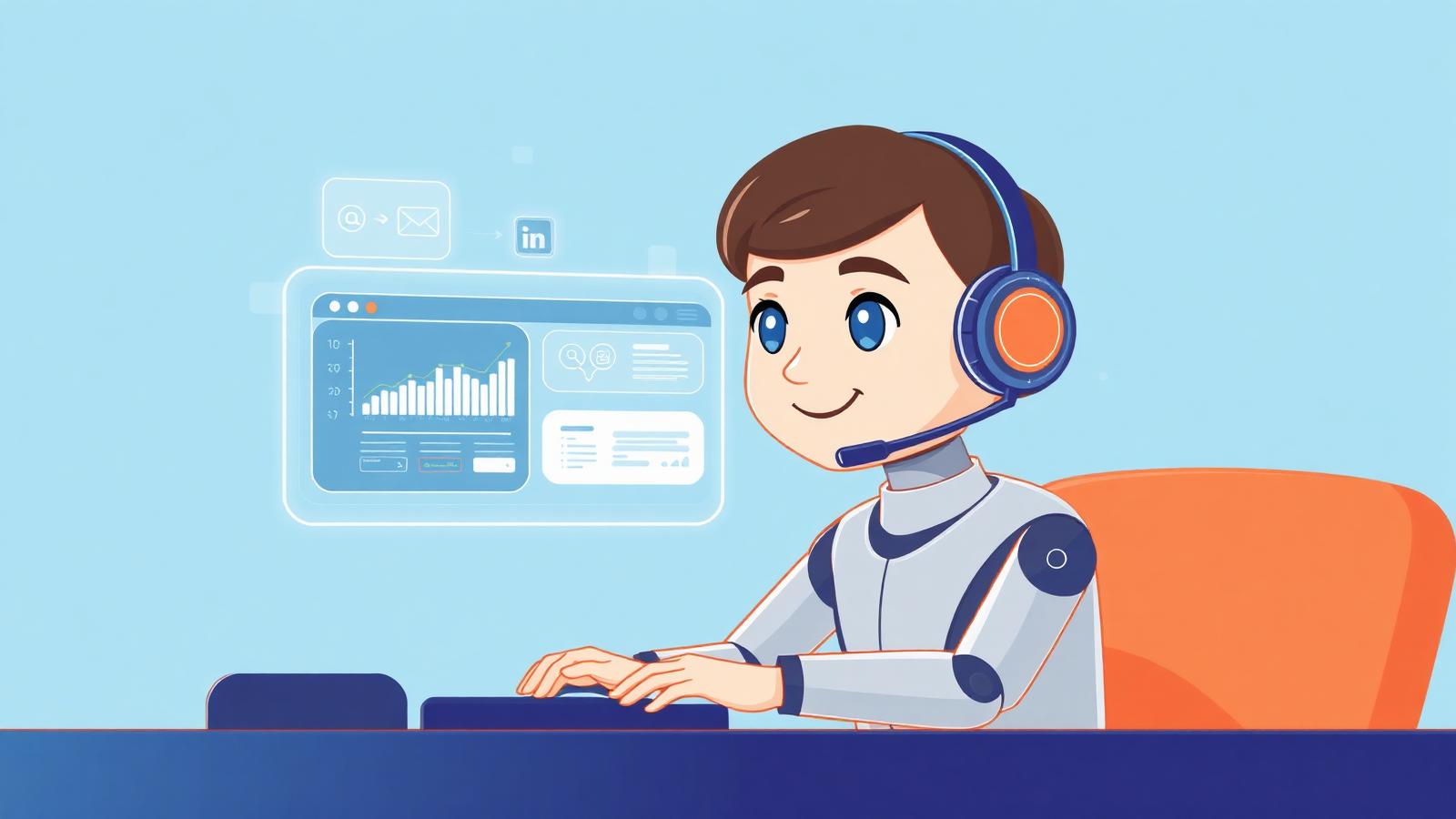
The AI SDR — an AI Sales Development Rep — is the single biggest shift in B2B outbound since sequencers arrived a decade ago. Done well, an AI SDR handles the mechanical 80% of prospecting (research, list building, first-touch personalization, follow-ups, meeting scheduling) so humans stay on the calls that actually close. Done badly, it becomes a spam cannon that torches your domain reputation in a week. This guide is the operator's playbook we use at GetLeadExpo.
TL;DR
An AI SDR is an AI Agent that runs the top of your sales funnel: it enriches leads, writes personalized outreach across email and LinkedIn, handles replies, and books qualified meetings on a human AE's calendar. Best-in-class AI SDRs in 2026 deliver 2–4x the output of a human SDR at 20–35% of the cost, but only when paired with a clean ICP, verified data, and human review on messaging. Treat it as a teammate, not a magic button.
Table of Contents
- 1. What is an AI SDR?
- 2. AI SDR vs traditional SDR vs sequencer
- 3. What AI SDRs actually automate
- 4. The AI SDR tech stack
- 5. Benchmarks and realistic results
- 6. How to deploy an AI SDR in 30 days
- 7. Where AI SDRs fail (and how to prevent it)
- 8. Best AI SDR platforms in 2026
- 9. Cost and ROI math
- 10. FAQs
1. What is an AI SDR?
An AI SDR is an autonomous or semi-autonomous system that performs the core work of a Sales Development Rep: identify accounts and contacts that fit your ICP, research each one, send personalized outreach across email, LinkedIn, and sometimes voice, handle inbound replies, and book qualified meetings for a human AE.
Under the hood it is an AI Agent (usually GPT-4-class or Claude-class) wired to your data sources (CRM, Apollo, Clay, Sales Navigator), a deliverability infrastructure (multiple inboxes, warmed domains), and a scheduling layer (Chili Piper, Cal.com). The reasoning layer decides *who* to contact, *what* to say, and *when* — the deterministic layer moves the data and sends the messages.
2. AI SDR vs traditional SDR vs sequencer
- Sequencer (Outreach, Salesloft, Instantly) — sends the same template to a list on a schedule. No reasoning. Personalization is a mail-merge field.
- Traditional SDR — human researches accounts, writes messages, handles replies. High quality, low volume, expensive.
- AI SDR — combines the volume of a sequencer with the reasoning of a human. Reads a prospect's LinkedIn, recent posts, company news, and open roles, then writes a message that actually sounds like it was written for them.
The step-change is *inference at every touch*, not just a static template.
3. What AI SDRs actually automate
A production AI SDR runs six loops:
- Sourcing — pulls accounts from Apollo, ZoomInfo, Sales Navigator, or Clay based on ICP filters plus trigger signals (hiring, funding, tech stack changes).
- Enrichment — verifies emails (MillionVerifier, NeverBounce), pulls firmographics, and reads LinkedIn activity for personalization angles.
- Personalization — an LLM writes a first-line hook grounded in a real signal (a recent post, hire, product launch), not a generic "loved your website" line.
- Sending + deliverability — rotates across warmed inboxes, throttles volume, respects SPF/DKIM/DMARC. See [Email Deliverability Guide](/blog/email-deliverability-guide-keep-emails-out-of-spam).
- Reply handling — classifies replies (positive, objection, not now, unsubscribe), drafts a response, and routes qualified leads to an AE with the full context.
- Meeting booking — pushes booked calls into the CRM with the enrichment payload attached, so the AE walks in prepared.
4. The AI SDR tech stack
A realistic 2026 stack:
- Data — Clay + Apollo or ZoomInfo, plus Sales Navigator for LinkedIn signals.
- Reasoning — GPT-4.1 / Claude 3.7 (or an AI SDR platform that abstracts this).
- Sending — Instantly / Smartlead for email, Heyreach or Lemlist for LinkedIn.
- Orchestration — n8n or a purpose-built AI SDR platform ties the loops together.
- CRM — HubSpot or Salesforce as the source of truth.
- Deliverability — 5–20 warmed inboxes across secondary domains, MillionVerifier on every send.
The glue is what most teams underestimate. [Building AI Agents with n8n](/blog/building-ai-agents-with-n8n) walks through the wiring pattern in detail.
5. Benchmarks and realistic results
Honest 2026 numbers from AI SDR deployments in the $10–$50k ACV band:
- Volume — 800–2,500 personalized touches per week per AI SDR "seat".
- Open rate — 45–65% (deliverability, not copy, drives this).
- Reply rate — 6–12% on cold email, 12–25% on LinkedIn DMs after acceptance.
- Positive reply rate — 1.5–3% of sends.
- Meetings booked — 8–25 per month per AI SDR seat on a clean ICP.
- Cost per booked meeting — $60–$180 all-in, vs $250–$700 for a human SDR.
Numbers above these are usually a spam problem waiting to be a compliance problem. Numbers below usually mean the ICP or offer is off — no AI fixes that.
6. How to deploy an AI SDR in 30 days
- Days 1–5 — nail the ICP and offer. Skip this and everything downstream is noise. See [ICP to Outbound Framework](/blog/icp-to-outbound-framework).
- Days 6–10 — build deliverability infrastructure: secondary domains, 10+ warmed inboxes, SPF/DKIM/DMARC, verified list.
- Days 11–15 — write the messaging framework and personalization prompts. Every prompt must ground on a real signal.
- Days 16–20 — wire the stack (Clay + Instantly + n8n + CRM). Test end-to-end with 50 prospects.
- Days 21–25 — soft launch at 20% volume. Human reviews every message for the first week.
- Days 26–30 — scale to full volume. Instrument reply routing, meeting booking, and CRM handoff.
Rushing to full volume in week one is how domains get burned.
7. Where AI SDRs fail (and how to prevent it)
- Generic personalization. "I saw you work at [Company]" is worse than no personalization. Ground every hook on a specific, recent signal.
- Bad list. AI can't fix a broken ICP. Verify email, role, and at least one trigger flag on every record.
- Reply blindness. If the AI can't classify "not the right person" or "unsubscribe" correctly, you get compliance risk and CRM chaos. Human review the classifier weekly.
- No human handoff. Booked meetings without full context waste AE time. Push the enrichment payload into the CRM on every booking.
- Ignoring deliverability. Domain reputation dies in silence. Monitor inbox placement weekly with GlockApps or Warmup Inbox.
8. Best AI SDR platforms in 2026
Well-known options in the category:
- 11x.ai (Alice) — end-to-end AI SDR, strong on inbound and hybrid motions.
- Regie.ai — AI-personalized sequences with human oversight.
- AiSDR — turnkey European-friendly option, HubSpot-native.
- Artisan (Ava) — full-stack AI SDR with sourcing baked in.
- Clay + Instantly + n8n — build-your-own stack, maximum control, lower cost.
There is no "best" — the right platform depends on your ICP volume, ACV, and how much control you want over messaging. Most teams under $10M ARR are better off with a hybrid: platform for sending, custom prompts and reply handling on top.
9. Cost and ROI math
Typical 2026 economics for an AI SDR "seat":
- AI SDR platform — $1,500–$5,000 / month.
- Data (Clay, Apollo, Sales Navigator) — $600–$1,500 / month.
- Deliverability (inboxes, domains, warmup, verification) — $300–$800 / month.
- All-in cost — $2,500–$7,000 / month.
Against a fully loaded human SDR at $8,000–$14,000 / month in the US (salary, benefits, tools, management), a single AI SDR seat produces 2–4x the meetings at 20–35% of the cost. The ROI question is not whether — it is *how fast can you deploy without breaking deliverability*.
10. FAQs
What does an AI SDR actually do?
Sources ICP-fit accounts, enriches them, personalizes and sends outreach across email and LinkedIn, handles replies, and books qualified meetings on a human AE's calendar — all with human oversight on messaging.
Will an AI SDR replace human SDRs?
Not fully in 2026. AI SDRs replace the mechanical work — sourcing, first-touch, follow-ups, scheduling. Humans still own discovery calls, complex objections, and multi-thread selling on named accounts.
How much does an AI SDR cost?
$2,500–$7,000 / month all-in for platform, data, and deliverability. A fully loaded human SDR in the US is $8,000–$14,000 / month. AI SDRs win on cost per booked meeting by 2–4x when deployed correctly.
Are AI SDRs GDPR and CAN-SPAM compliant?
The tools are, but compliance is on you. Maintain opt-out on every send, honor unsubscribes within 10 business days, and document lawful basis for B2B contact data under GDPR (legitimate interest with balancing test).
Can an AI SDR handle inbound too?
Yes — the best platforms qualify inbound leads with a chat or email flow, book meetings, and enrich the CRM. Same reasoning layer, different trigger.
How long until an AI SDR produces meetings?
30–45 days end-to-end if the ICP and deliverability are ready. Domain warmup alone is 14–21 days — you cannot compress that safely.
AI SDR vs sales sequencer — what is the real difference?
A sequencer sends templates on a schedule. An AI SDR reasons at every touch — reads the prospect, grounds the message on a real signal, and adapts based on replies. The output looks like personalized outreach because it is.
Deploy an AI SDR without burning your domain
GetLeadExpo builds and operates AI SDR stacks end-to-end — ICP, deliverability infrastructure, personalization prompts, reply handling, and CRM automation. You get booked meetings on your AE's calendar, not a science project.
<presentation-actions> <presentation-link url="/services/b2b-lead-generation">Explore B2B Lead Generation</presentation-link> <presentation-link url="/contact">Book a free strategy call</presentation-link> </presentation-actions>
Related services
- [B2B Lead Generation](/services/b2b-lead-generation)
- [Cold Email Setup](/services/cold-email-setup)
- [CRM Automation](/services/crm-automation)
Related articles
- [AI-Powered B2B Lead Generation 2026](/blog/ai-powered-b2b-lead-generation-2026)
- [B2B Lead Generation Strategies 2026](/blog/b2b-lead-generation-strategies-2026)
- [B2B Cold Email Templates That Convert](/blog/b2b-cold-email-templates-that-convert)
- [LinkedIn Lead Generation Guide 2026](/blog/linkedin-lead-generation-guide-2026)
- [B2B Sales Funnel Guide 2026](/blog/b2b-sales-funnel-guide-2026)
- [ICP to Outbound Framework](/blog/icp-to-outbound-framework)
- [Email Deliverability Guide](/blog/email-deliverability-guide-keep-emails-out-of-spam)
Ashikur Rahman
Founder, GetLeadExpo
Writing about B2B lead generation, deliverability, and n8n AI automation at GetLeadExpo.