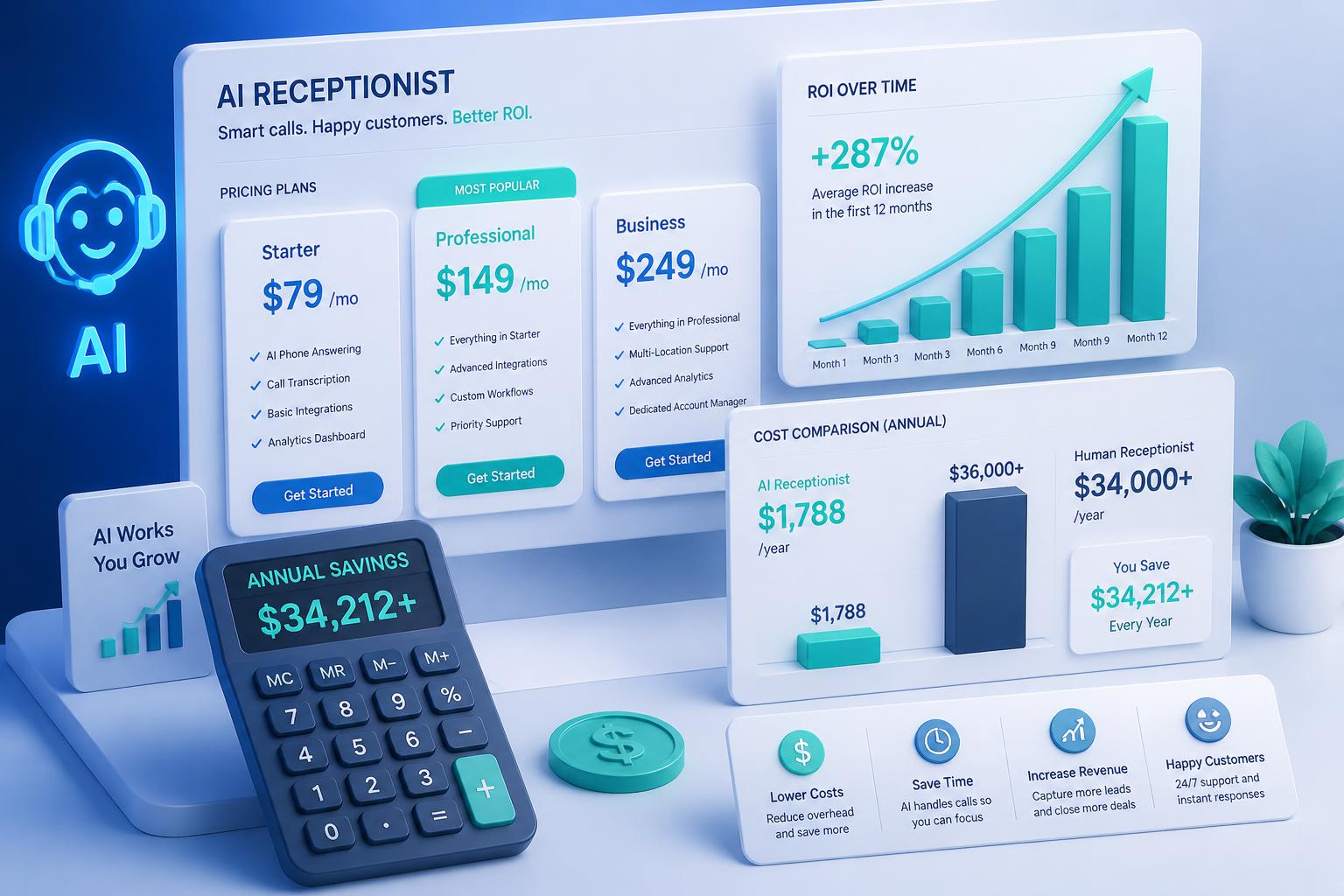
AI Receptionist Pricing in 2026 is confusing on purpose. Ask ten vendors what their software costs and you'll get ten different pricing models — flat monthly, per-minute, per-conversation, per-resolved-conversation, per-seat, plus setup fees, voice-vs-chat surcharges, and overage rates buried three clicks deep. That opacity is the single biggest reason buyers overpay.
This guide fixes that. We'll walk through what an AI receptionist actually costs in 2026, the three AI receptionist pricing models the market has settled into, tier-by-tier inclusions, hidden fees, a quick pricing calculator, a vendor evaluation checklist, and honest comparisons against a [human receptionist](/blog/ai-receptionist-vs-human-receptionist), an answering service, and a traditional call center. For fundamentals, start with [What Is an AI Receptionist?](/blog/what-is-an-ai-receptionist); for feature-level ROI, see [AI Receptionist Benefits](/blog/ai-receptionist-benefits); and to shortlist vendors, use [Best AI Receptionist Software](/blog/best-ai-receptionist-software).
Table of Contents
- 1. The one-line answer
- 2. The three pricing models in 2026
- 3. Typical monthly cost by business size
- 4. What each tier actually includes
- 5. Setup fees and one-time costs
- 6. Hidden fees to watch for
- 7. Voice vs chat vs omnichannel — why the price gap
- 8. AI receptionist vs human receptionist cost
- 9. AI receptionist vs answering service cost
- 10. Custom-built vs off-the-shelf cost
- 11. Quick AI receptionist pricing calculator
- 12. Questions to ask every vendor before buying
- 13. AI receptionist pricing vs alternatives (comparison)
- 14. How to calculate ROI for your business
- 15. How to negotiate the best deal
- 16. FAQ (AI receptionist pricing)
- 17. Bottom line
1. The One-Line Answer
For most SMBs, a production-ready AI receptionist costs $199-$1,500/month, plus a one-time setup fee of $0-$5,000 depending on integration depth. Enterprise and regulated-industry deployments run $1,500-$5,000+/month. Payback period is almost always under 60 days.
Now the details.
2. The Three Pricing Models in 2026
Vendors sell you one of these three (and occasionally a hybrid).
Model A — Flat monthly subscription
You pay a fixed price and get a set of features plus a capped volume of interactions (calls, minutes, conversations, or resolved sessions).
- Pros: predictable, budget-friendly, encourages you to actually route traffic to the AI instead of hoarding it.
- Cons: you pay the same whether you use 50% or 100% of your cap. Overage rates can bite hard.
- Typical range: $99-$1,500/month for SMB tiers.
Model B — Per-minute (voice) or per-conversation (chat)
Pay only for what you use. Common with voice-first vendors like Bland, Retell, Vapi, and enterprise omnichannel platforms.
- Pros: great at low volume, no wasted seat fees.
- Cons: costs scale linearly with success. If your AI works well and volume grows, so does the bill.
- Typical range: $0.10-$0.35 per voice-minute, $0.05-$0.50 per chat conversation.
Model C — Per-resolved-conversation
You pay only when the AI resolves an issue end-to-end without escalating to a human. Popularized by Intercom Fin and copied since.
- Pros: aligns vendor incentives with resolution rate. Zero cost if the AI can't handle your traffic.
- Cons: definition of "resolved" varies by vendor. Read the contract carefully.
- Typical range: $0.50-$1.25 per resolved conversation.
Some vendors combine models — a low flat base plus per-minute over the cap. That's usually the honest sweet spot for growing businesses.
3. Typical Monthly Cost by Business Size
Real-world pricing ranges we see with clients in 2026:
- Solo practice / one-location SMB (~100-300 monthly interactions): $199-$499/month.
- Small multi-location (~300-1,000 monthly interactions): $499-$999/month.
- Medium multi-location (~1,000-3,000 monthly interactions): $999-$2,000/month.
- Regional or national brand (~3,000-10,000+ monthly interactions): $2,000-$5,000+/month.
- Enterprise / regulated: custom quotes, typically $5,000-$25,000/month.
All of the above are subscription only — add setup fees separately (next section).
4. What Each Tier Actually Includes
Ignore feature-list marketing and check for these specific inclusions before signing.
Entry ($99-$499/month)
- One channel — usually voice OR chat, rarely both.
- 200-500 conversations or 300-1,000 voice minutes included.
- Standard integrations (Google Calendar, one CRM).
- Templated knowledge base.
- Email support only.
Growth ($500-$1,500/month)
- Two or three channels (voice + chat, sometimes + SMS).
- 1,000-3,000 conversations or 2,000-6,000 voice minutes included.
- Full integration set (multiple calendars, CRMs, PMS/EHR options).
- Custom knowledge base you can edit yourself.
- Custom voice option.
- Business-hours phone/chat support.
Scale ($1,500-$3,000/month)
- True omnichannel with cross-channel memory.
- 3,000-10,000 conversations or 6,000-15,000 minutes.
- HIPAA BAA / SOC 2 / GDPR controls.
- Multiple locations / brands / phone numbers.
- Dedicated onboarding + success manager.
Enterprise ($3,000+/month)
- Unlimited channels and volume.
- Private-cloud or on-prem deployment options.
- Custom LLM tuning / retrieval.
- SLA-backed uptime.
- Named account team.
5. Setup Fees and One-Time Costs
Almost every vendor charges an implementation fee. Ranges:
- Self-serve entry tier: $0 setup.
- Standard SMB tier: $500-$1,500 setup — includes knowledge-base build, one calendar and one CRM integration, brand voice, QA.
- Growth tier: $1,500-$3,500 — adds multi-integration, custom voice, escalation logic, staff training.
- Enterprise / regulated: $5,000-$25,000+ — dedicated project manager, compliance documentation, custom integrations.
Custom-built deployments (see section 10) have larger up-front builds — typically $3,000-$15,000 — but zero platform lock-in.
6. Hidden Fees to Watch For
Line-by-line checks before you sign anything:
- Overage rates. Cap price times unit cost — how bad does the bill get if you're 2x over cap?
- Voice minute rounding. Per-minute or per-6-second? Difference matters at scale.
- Additional phone numbers. Some vendors charge $10-$25 per number/month.
- Extra language support. Multilingual should be included; some vendors charge extra per language.
- Transcription storage. How long are transcripts retained free? Fees kick in after 30/90/180 days on some plans.
- API access. Enterprise-only on many platforms. Confirm it's included at your tier if you need it.
- CRM integration credits. Some vendors count CRM writes against your conversation cap.
- Human handoff costs. If handoff goes to *their* human team, that's answering-service pricing on top of the AI fee.
- SMS / WhatsApp per-message charges. Meta and Twilio pass-through costs sometimes billed separately.
- Custom voice fee. $50-$300/month on some vendors for a cloned or premium voice.
- Reporting exports. Some vendors gate CSV export behind higher tiers.
Ask for a *total-cost-of-ownership* quote at your projected 12-month volume — not month one. That single request has saved GetLeadExpo clients five figures more than once.
7. Voice vs Chat vs Omnichannel — Why the Price Gap
- Chat-only is cheapest because there's no telephony, STT, or TTS cost. Vendors pay only LLM tokens.
- Voice-only is 2-4x more expensive per interaction due to Twilio + Deepgram + ElevenLabs pass-through costs plus the engineering cost of real-time turn-taking.
- Omnichannel carries a premium (~1.5x voice-only) for the cross-channel memory infrastructure and unified analytics.
If your customers overwhelmingly use one channel, don't pay for omnichannel. See channel-mix guidance in [How an AI Receptionist Works](/blog/how-ai-receptionist-works).
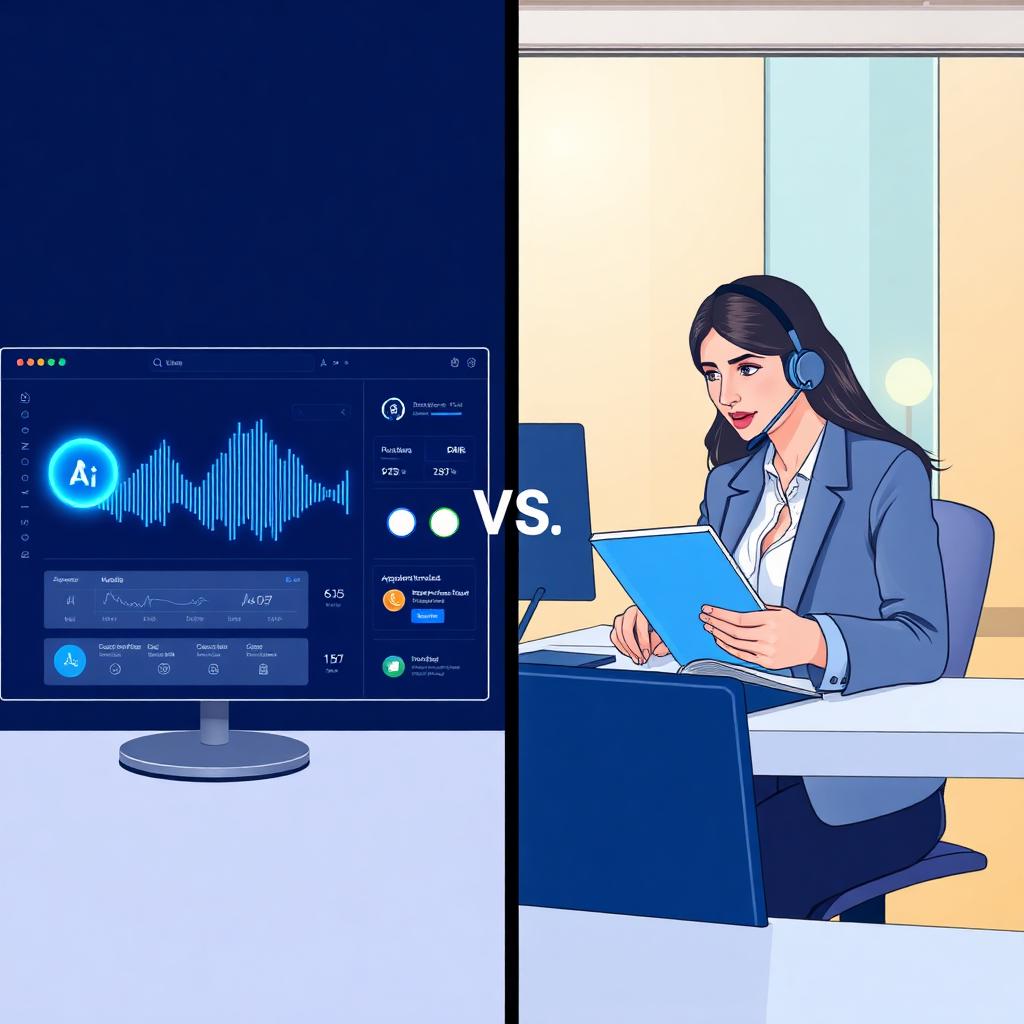
8. AI Receptionist vs Human Receptionist Cost
A fair comparison — not just base salary.
Human receptionist (US 2026, single hire):
- Base salary: $2,800-$4,200/month.
- Benefits & taxes (~25%): $700-$1,050/month.
- Coverage gaps (PTO, sick days, turnover): missed revenue we don't count above.
- Physical desk, tools, training: $200-$400/month amortized.
- Fully-loaded: $3,700-$5,650/month for 40 hrs/week, 5 days/week coverage.
- No coverage for evenings, weekends, or spikes.
AI receptionist (Growth tier):
- Subscription: $499-$1,500/month.
- Setup amortized over 12 months: $100-$300/month.
- Total: $600-$1,800/month for 24/7/365, unlimited concurrent calls.
Verdict: AI is roughly 1/3 the cost for 4x the coverage. Full analysis in [AI Receptionist vs Human Receptionist](/blog/ai-receptionist-vs-human-receptionist).
9. AI Receptionist vs Answering Service Cost
Answering services (Ruby, PATLive, Smith.ai's human tier, AnswerConnect) typically charge per-minute or per-call.
- Human answering service: $0.90-$1.75 per minute, or ~$1.50-$3.50 per call. At 500 monthly calls averaging 3 minutes: $1,350-$2,625/month, and they take messages — they don't book appointments or update your CRM.
- AI receptionist (Growth tier): $499-$1,500/month flat, and they *book* the appointment, *write* the lead, and *fire* the follow-up.
AI wins on price and functionality. Human answering services still have a role for genuinely complex escalations, but that's a small share of volume.
10. Custom-Built vs Off-the-Shelf Cost
Custom-built (on Twilio + Deepgram + OpenAI/Anthropic + ElevenLabs + [n8n](/n8n-automation)) has a different cost structure:
- Setup: $3,000-$15,000 one-time (depending on integrations and compliance).
- Monthly platform pass-through: $200-$900 (Twilio + Deepgram + LLM tokens + TTS + hosting).
- Optional build-partner retainer: $500-$2,500/month for ongoing changes and monitoring.
Total: $700-$4,000/month all-in, with full data ownership, no vendor lock-in, and unlimited customization. For businesses with unusual requirements or growing beyond 3,000 monthly interactions, this typically wins on 24-month TCO.
At GetLeadExpo we build custom deployments in this bracket. See [Building AI Agents with n8n](/blog/building-ai-agents-with-n8n) for the technical side.
11. Quick AI Receptionist Pricing Calculator
Use the table below to estimate a realistic monthly AI receptionist pricing range based on your call volume and average call duration. Multiply monthly calls × avg minutes to get monthly minutes, then map to the pricing bracket that best matches a modern per-minute or flat-rate plan (typical $0.20–$0.40/min effective rate at mid volumes; flat-rate wins above ~500 calls/month).
| Monthly Call Volume | Avg Call Duration | Est. Monthly Minutes | Est. Monthly Cost (USD) | Recommended Model | |---|---|---|---|---| | 50 calls | 2 min | 100 min | $29 – $99 | Free / Entry per-minute | | 200 calls | 3 min | 600 min | $149 – $299 | Entry flat-rate | | 500 calls | 3 min | 1,500 min | $299 – $599 | Growth flat-rate | | 1,000 calls | 4 min | 4,000 min | $599 – $1,200 | Business flat-rate | | 2,500 calls | 4 min | 10,000 min | $1,200 – $2,500 | Business + overage cap | | 5,000+ calls | 4–5 min | 20,000+ min | $2,500 – $5,000+ | Enterprise / custom-built |
Add $500–$5,000 one-time setup and any per-integration or compliance (HIPAA/PCI) fees. Want an exact number for your business? [Book a free consultation](/contact) and we'll price a deployment against your live call logs.
12. Questions to Ask Every Vendor Before Buying
Before you sign anything, run every shortlisted vendor through this checklist. It surfaces the hidden costs and lock-in risks that turn a "great deal" into a bad 12-month contract.
Pricing & billing
- What is your exact AI receptionist pricing model — flat, per-minute, per-conversation, or per-resolved-conversation?
- What counts as a billable "conversation" or "minute"? Are failed transfers, voicemails, and spam calls charged?
- What is the overage rate, and can we contractually cap it?
- Are setup, onboarding, and training fees one-time or recurring?
- Do you offer annual prepay discounts or multi-location bundling?
Product & scope
- Is voice included, or is it an add-on to the chat tier?
- Which channels are included: voice, SMS, WhatsApp, web chat, email?
- How many languages are supported at the price shown?
- Is custom or cloned voice included, or a paid upgrade?
Integrations & data
- Which CRMs, calendars, and PMS/EHR systems are natively supported?
- Are custom integrations billed hourly, per-integration, or included?
- Who owns the call recordings, transcripts, and training data?
- Can we export our data if we leave? In what format?
Compliance & security
- Are you HIPAA / PCI / GDPR / SOC 2 compliant? Which tier includes it?
- Where is data stored and processed? Is a BAA/DPA available?
Support & SLAs
- What's the uptime SLA and remedy if breached?
- Is 24/7 support included, or gated behind a higher tier?
- What's the standard response time for P1 incidents?
Contract terms
- Minimum term? Auto-renewal clauses? Notice period to cancel?
- Price-hold guarantee for 12 or 24 months?
- Can we start on a 30-day pilot before committing?
If a vendor won't answer any of these in writing, treat it as a red flag. See our full evaluation framework in [Best AI Receptionist Software](/blog/best-ai-receptionist-software).
13. AI Receptionist Pricing vs Alternatives (Cost Comparison)
The fairest way to evaluate AI receptionist pricing is against the three real alternatives most businesses are already paying for: an in-house human receptionist, an outsourced answering service, or a traditional call center. Here's the honest side-by-side for a mid-sized SMB handling ~1,000 calls/month with some after-hours coverage.
| Dimension | AI Receptionist | Human Receptionist (FTE) | Answering Service | Traditional Call Center | |---|---|---|---|---| | Typical monthly cost | $299 – $1,500 | $3,500 – $6,000 (loaded) | $300 – $1,500 | $2,500 – $10,000+ | | Setup / one-time | $0 – $5,000 | Recruiting + training $2k–$5k | $0 – $250 | $5,000 – $25,000 | | Per-minute / per-call rate | $0.20 – $0.40 (or flat) | N/A | $1.00 – $2.50/min | $0.80 – $2.00/min | | Hours of coverage | 24/7/365 | ~40 hrs/week | 24/7 (shared agents) | 24/7 (dedicated shifts) | | Concurrent calls handled | Unlimited | 1 | 3 – 10 | 20 – 500+ | | Missed-call rate | ~2 – 5% | 20 – 35% | 5 – 15% | 3 – 10% | | Consistency & QA | 100% recorded + scored | Variable, human-day dependent | Variable per agent | Scripted, monitored | | CRM / calendar integration | Native, real-time | Manual | Limited | Custom, expensive | | Multilingual | Included / low add-on | 1 language typically | Limited | High cost per language | | Scales to 2× volume | Instantly, same price | Hire + train (weeks) | Higher per-minute | Contract renegotiation | | Compliance (HIPAA/PCI) | Included on higher tiers | Training required | Extra fee | Extra fee | | All-in 12-month TCO | $4k – $22k | $45k – $75k | $5k – $20k | $35k – $130k |
Bottom line: For 1,000 calls/month, AI receptionist pricing runs 60–80% cheaper than an FTE, ships 24/7 coverage that a single receptionist can't provide, and beats the concurrency ceiling of most answering services. Answering services are cost-competitive at low volumes but lose on integration depth and per-minute economics as you scale. Traditional call centers only win when you need very high concurrent volume with human judgment on every call.
14. How to Calculate ROI for Your Business
Simple formula:
- Recovered revenue = (missed-call rate today − 3%) × monthly call volume × booking rate × avg customer value
- After-hours revenue = after-hours share × monthly volume × booking rate × avg value
- Labor savings = current receptionist / answering-service cost − AI cost
- Total gain = recovered + after-hours + labor savings
- ROI = total gain ÷ AI cost
Worked example — mid-size clinic:
- 800 monthly calls, 22% missed rate, 30% after-hours share, 25% booking rate, $250 avg patient value.
- Recovered revenue: (0.22 − 0.03) × 800 × 0.25 × $250 = $9,500/month.
- After-hours revenue: 0.30 × 800 × 0.25 × $250 = $15,000/month.
- Labor savings vs one FTE: $3,500/month.
- Total gain: ~$28,000/month.
- AI cost: ~$999/month.
- ROI: ~28x.
Numbers vary, but the pattern is stable across industries. See specific vertical ROI in [AI Receptionist for Medical Clinics](/blog/ai-receptionist-for-medical-clinics) and coming articles for dental, legal, hospitality, and real estate.
15. How to Negotiate the Best Deal
Vendors have more room than they advertise. Real levers:
- 12-month prepay — usually gets 10-20% off.
- Multi-location bundling — negotiate a per-location rate rather than per-brand.
- Case-study rights — agree to be a named reference in exchange for 10-25% discount.
- Higher-tier at lower-tier price for the first quarter — most vendors will do this to prove out ROI.
- Waive setup fee on 12-month commit.
- Cap overage rates contractually — the biggest single line item you can protect.
If you're evaluating custom-built vs a big platform, mention it. It puts real price pressure on the vendor sales team.
16. Frequently Asked Questions (AI Receptionist Pricing)
How much does an AI receptionist cost per month in 2026?
Most SMBs pay $299 – $1,500 per month for a fully-featured AI receptionist, plus a one-time setup fee of $500 – $5,000. Entry-level plans start around $29 – $99/month for very low call volumes, while enterprise deployments with HIPAA/PCI compliance and multi-location routing run $2,500 – $5,000+ per month.
Is an AI receptionist cheaper than a human receptionist?
Yes. A fully-loaded human receptionist costs $3,500 – $6,000/month once you include benefits, PTO coverage, and turnover, and only covers ~40 hours per week. An AI receptionist provides 24/7 coverage, unlimited concurrent calls, and CRM integration for $299 – $1,500/month — typically 60–80% cheaper on 12-month total cost. See [AI Receptionist vs Human Receptionist](/blog/ai-receptionist-vs-human-receptionist) for the full breakdown.
What is the average per-minute AI receptionist pricing?
Effective per-minute AI receptionist pricing ranges from $0.20 to $0.40 per minute at typical SMB volumes, compared to $1.00 – $2.50/min for a traditional answering service. Above ~500 calls/month, flat-rate plans almost always beat per-minute pricing on total cost.
Are there hidden fees in AI receptionist pricing?
The most common hidden fees are: setup and onboarding, per-integration charges, overage rates above your included minutes, custom-voice add-ons, HIPAA/PCI compliance upgrades, SMS/WhatsApp pass-through fees, and phone-number porting. Always ask for a written quote covering all seven — see the vendor checklist in Section 12.
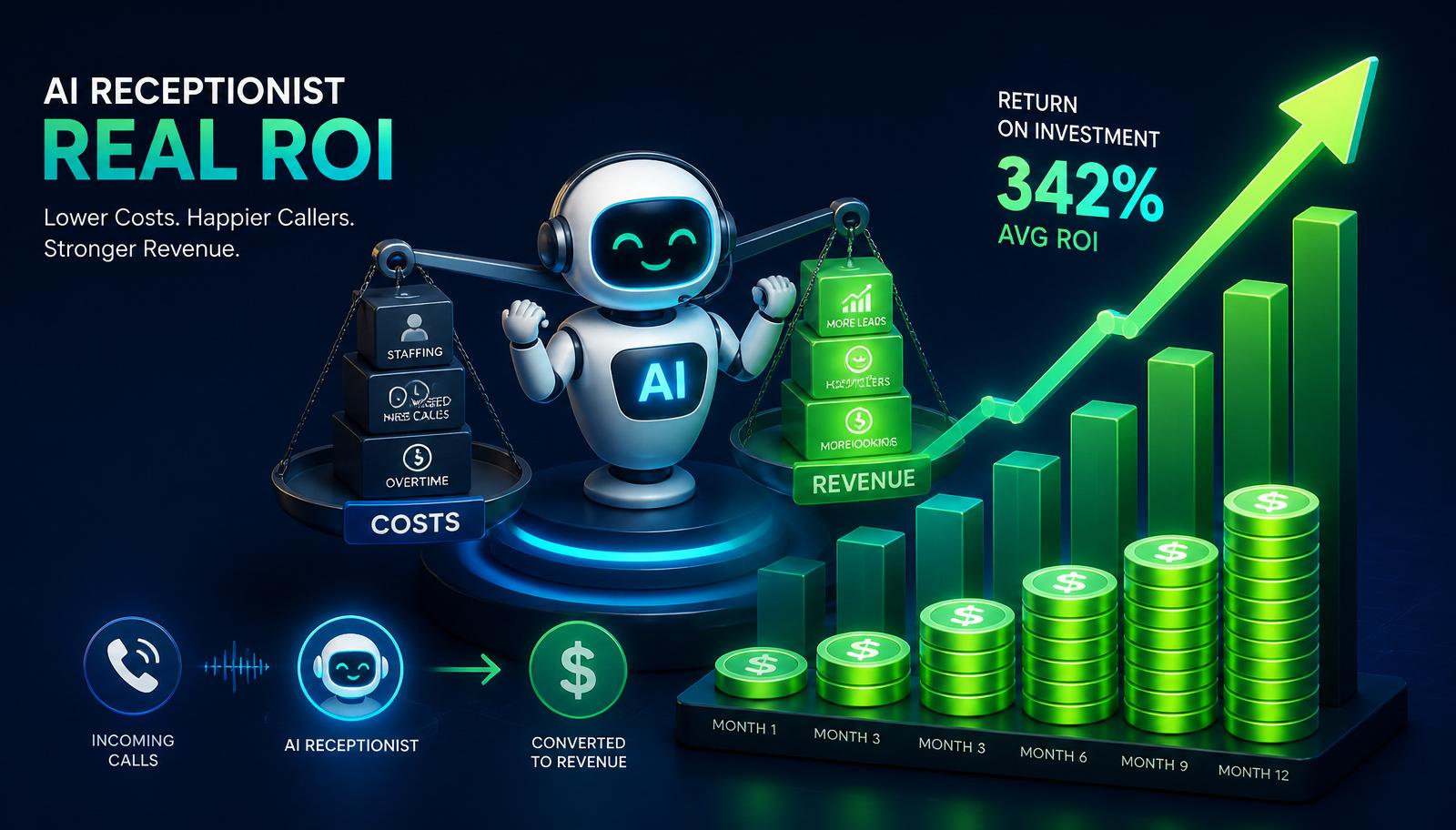
What is a good ROI for an AI receptionist?
Most SMBs see 10x – 30x ROI in the first 12 months, driven by recovered missed-call revenue, after-hours bookings, and labor savings. A typical mid-size clinic recovers $25,000+ per month in missed revenue against a $999 subscription. See the full ROI model in the upcoming [AI Receptionist ROI](/blog/ai-receptionist-roi) guide.
Is there a genuinely free AI receptionist?
Some vendors have free tiers capped at 50-100 conversations/month — useful for a real business only if you're a solo operator with minimal volume. Otherwise, budget at least $199/month.
Is per-minute always more expensive than flat-rate?
At low volume, per-minute is cheaper. Around 300-500 monthly calls the crossover happens and flat-rate wins.
Do I need to pay for a phone number?
Usually included on the platform's own numbers. Porting your own number is often free but takes 2-4 weeks.
What about SMS/WhatsApp costs?
Meta and Twilio pass-through fees (~$0.005-$0.05 per message) are often billed separately. Not a big line item unless you're doing high-volume outbound.
Do I need to pay extra for custom voice?
$0-$300/month depending on vendor. Cloned voices (your own receptionist's, with permission) sometimes carry a one-time cloning fee ($100-$500).
Should I lock in an annual contract?
Only if you've completed a 2-week bake-off (see [Best AI Receptionist Software](/blog/best-ai-receptionist-software)) and you're confident on fit. Annual saves 10-20%, but a bad annual is very expensive.
What's the fastest way to get a real quote?
Give vendors your monthly call volume, channel mix, three must-have integrations, and any compliance requirements. Serious vendors return a fixed quote within 24 hours.
17. Bottom Line
AI receptionist pricing in 2026 is not complicated once you understand the three models, the four tiers, and the six hidden-fee traps. For most SMBs, $299 – $1,500/month buys a fully-featured deployment that pays back within 60 days — dramatically cheaper than a human receptionist, more capable than an answering service, and more flexible than a traditional call center. Skip the entry tier if your volume justifies it, and always price-check per-minute against flat-rate at your projected 12-month volume.
Next steps:
- See working AI receptionists in the [interactive demo hub](/demo).
- Compare against a human in [AI Receptionist vs Human Receptionist](/blog/ai-receptionist-vs-human-receptionist).
- Shortlist platforms in [Best AI Receptionist Software](/blog/best-ai-receptionist-software).
- Model your payback in [AI Receptionist ROI](/blog/ai-receptionist-roi).
- Understand the value in [AI Receptionist Benefits](/blog/ai-receptionist-benefits).
- Ready for a fixed quote? [Book a free consultation](/contact) and we'll price a custom-built deployment for you.
---
Related services
- [AI Receptionist](/services/ai-receptionist)
- [n8n Automation](/n8n-automation)
Related articles
- [What Is an AI Receptionist?](/blog/what-is-an-ai-receptionist)
- [How an AI Receptionist Works](/blog/how-ai-receptionist-works)
- [AI Receptionist Benefits](/blog/ai-receptionist-benefits)
- [Best AI Receptionist Software](/blog/best-ai-receptionist-software)
- [AI Receptionist vs Human Receptionist](/blog/ai-receptionist-vs-human-receptionist)
- [AI Receptionist ROI](/blog/ai-receptionist-roi)
- [24/7 AI Receptionist](/blog/24-7-ai-receptionist)
Sources & further reading
- Twilio — Programmable Voice Pricing
- Deepgram — Streaming STT Pricing Benchmarks
- ElevenLabs — TTS Pricing Documentation
- G2 — AI Receptionist Software Pricing Category
- BLS — Receptionist Compensation, US 2026
Ashikur Rahman
Founder, GetLeadExpo
Writing about B2B lead generation, deliverability, and n8n AI automation at GetLeadExpo.